
Our Parks: Flagged for Review pt. 2
Some days I start a new book, and am overwhelmed by the amount of work, research, travel, and words ahead of me. Other days I’m bogged down by recent news stories or life events. There’s a lot going on. Most days though, when it comes to the Junior Rangers Investigative Club, I’m simply super excited that I have the opportunity to explore and share some of the coolest places on Earth with future readers. I’m overwhelmed, instead, by how awesome it is that I get to write about places like the Dry Tortugas, Biscayne, Mammoth Cave, Everglades, Big Cypress, Wupatki, Walnut Canyon, Sunset Crater, Dinosaur National Monument, and so many more. *
*(spoilers)
Our National Parks are astounding. They are beautiful. They are majestic. They are fascinating. They are examples of nature’s abundance. They preserve and promote our nation’s vast and varied history, and the history of this land long, long, before this nation even existed.* They provide opportunities for people to explore wild places, see cool wildlife, learn cool scientific and historic facts, and do cool things! And I write about them!** Rad!
*(also, don’t forget the pre-history)
** (hopefully some people read about them too!)
So, it’s always important to note that, even as I talk about fighting for parks, even when I cover some of the tragic crises currently impacting them, that I am also forever thrilled for the opportunity to champion them. For oh so many reasons. One of which is that new stories are still being written in our national parks.
One story I was thrilled to witness,* was the evolving legacy of the memorial to the Bransford family of Mammoth Cave. While I was writing The Specters of Mammoth Cave, I was fortunate enough to be introduced to a man named Gary who hikes, extensively, throughout Mammoth Cave National Park. And a few years ago, he graciously invited me along on several awesome hikes throughout the park, showing me some places I would never have discovered on my own. Some of which ended up in the book.
*(I play no part in this particular story, except that I got to see it progress. That’s another fun things about parks, even though they preserve historical places, new stories are happening in them all the time.)
One of the places Gary showed me, was a barely worn trail on the way to Great Onyx Cave. It was in the early stages of development, and couldn’t even really be considered a trail. But after we had hiked about a quarter mile into the woods, we came upon a small clearing, filled with stone markers. Headstones. The most prominent two belonging to a couple known as Henry and Anne Bradford. Gary explained that it was a small cemetery for a family with deep roots in Mammoth Cave. From the 1830s to 1941, the Bransfords had lived in the area for more than a century, working as cave guides and hosting tourists who would not otherwise have been able to visit the cave. The small plot was the resting remnants of a family legacy much older than Mammoth Cave National Park.
Soon after the war of 1812, the owners and operators of Mammoth Cave shifted to tourism. In less than 3 decades it became a popular tourist attraction. Guides would lead people into the deep and the dark, tell stories, explore caverns, and discover more of Mammoth Cave in their free-time.
Many of the early cave guides were enslaved men. Stephen Bishop was among some of the first guides. Alfred Crogan, Mat and Nick Bransford, and more came after. They each lead groups of tourists into Mammoth Cave, helped with the tourism industry above ground, and shaped the area’s legend. Stephen Bishop is, perhaps, the most well known of these men. He was widely known at the time, for both his exploration, (he discovered miles of passages, explored areas it would have been incredibly dangerous to cross while doing so, and even created his own map to help navigate the cave,) and also his experience as a guide, as people from around the world wrote about thier experience on his tours.
But he was not the only notable guide. The stories of these men describe a litany of accomplishments both above and beneath the surface. Matterson (Mat) Bransford and Nick Bransford both became semi-famous as guides. And they built homes, lives, and legacy’s in Mammoth Cave. It wasn’t all good. They were all enslaved. Mat Bransford and his wife Parthena, had 3 of 4 of their children sold away by their enslavers. Two of whom returned after the civil war, and one who never did. Stephen Bishop was able to purchase his freedom, but he died soon after, leaving his wife Charlotte and his son Thomas far too soon. Many of the guides in Mammoth Cave earned enough to purchase their freedom, but some, like Will Garvin, had to wait for the end of the Civil War, or enlist with with the Union Army at Camp Nelson to earn their freedom.
After emancipation, many of the black cave guides stayed on, continuing to lead tours. They made names for themselves, adding to the depth and breath of the cave cave, discovering new passages, and teaching others about the cave. Historically, some of their notable achievements are documented, like those of the men linked above along with Ed Hawkins and Ed Bishop, but I’m positive there are more stories out there to be found. And amongst the many families with stories to tell, the Bransfords stand out for a continued legacy at the cave.
As tourism went on and times changed, the Mat’s legacy as a cave guide was continued through his son Henry who, along with his wife Alice, have prominent headstones in the Bransford Cemetery. Henry’s children became a 3rd generation of guides in Mammoth Cave. Matt and Louis Bransford being the most prominent, but some of their siblings also seemed to have been guides as well.
It was the early 1900s in the south. Segregation was ongoing, and while the guides were accepted and allowed to lead underground, tour groups and lodging were segregated. Matt Bransford and his wife Zemmie opened and maintained a lodge for black tourists called the Bransford Summer Resort located somewhere near where the cemetery rests now. Three Generations of Bransfords served in the park, helping to grow and share it’s story. A fourth generation was growing up on the lands, and some of them also took on roles guiding tourists in Mammoth Cave. It was a family legacy which could have could have continued indefinitely.
However, when Mammoth Cave became a national park, many people were faced with an impossible choice, sell thier land or be forced off of it with imminent domain. While, initially, Matt spoke as though they intended to stay, eventually, they sold their land to the formation of the park, and moved to Glasgow.
The formation of the National Park came with other growing pains. In the 1940s, when segregation was still prevalent, it was up to regional directors to decide if parks would integrate their staff, or maintain the segregation. In much of the south, the choice was obvious. Segregation was upheld, and none of the black guides were hired to resume their jobs as park rangers. Some continued to work in the park, as part of the CCC, building trails in the caverns they had once lead tours through, but as that work dried up, so did their jobs in Mammoth Cave.
This could have been the end of the Bransford’s legacy in Mammoth Cave, but David Bransford who grew up along Flint Ridge shared his love of his “home” Mammoth Cave with his family, taking them to visit, and telling stories. And many many years later (60,) long after segregation had ended, Jerry Bransford, returned as 5th generation of Bransford to work as a guide in Mammoth Cave. You can watch him tell part of the story about his family’s legacy here.
All of this and more I learned while researching Mammoth Cave. Although, unfortunately, I was never able to run across Jerry Bransford while he was working in Mammoth Cave. Instead, I learned about the Bransfords from Gary, who took me off the path, and to the quiet cemetery where many of the past generations of Bransfords rest. When I returned home and did more research, I learned about Jerry Bransford, and about his goal to memorialize his family’s legacy in the park.
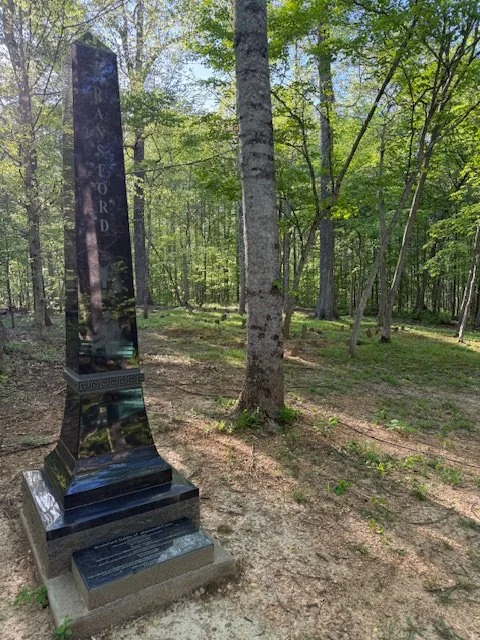
In the late 2010’s Jerry Bransford set out to get a monument designed and placed in the cemetery, marking it and his family’s history. While I was writing The Specters of Mammoth Cave, the black stone obelisk was still waiting for final approval inside the park. (There’s a long and bureaucratic process to putting any new memorials or monuments in parks.) Even so, I assumed the monument would be installed, because it seemed like a no-brainer that the Bransfords’ contribution to the park, and legacy within it deserved recognition.
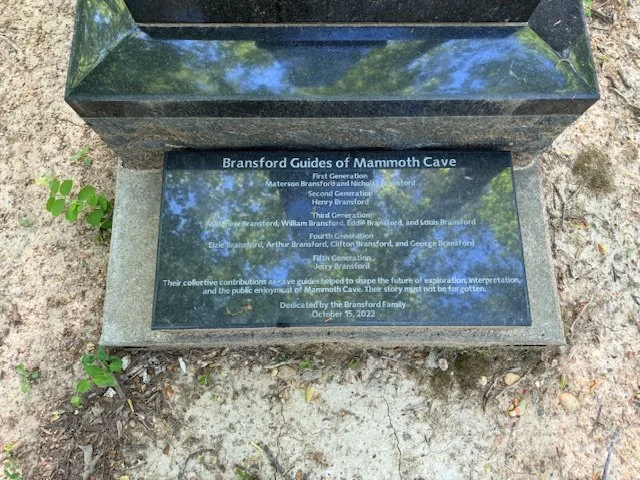
And I was, fortunately, correct. In 2022, the barely existent trail I’d hiked with Gary a couple years before was improved, and on October 15th the monument that Jerry had been working on was installed in Bransford Cemetary along with an informational sign explaining a brief summary of the Bransford Family’s long history in Mammoth Cave.
Now, the trail sits off to the left of the larger gravel road leading to Great Onyx Cave. It’s accessible to anyone who hikes in that section of Mammoth Cave National Park.* At the end of a quarter mile trail, visitors can see the monument, read the story, and pay their respects to the people resting in the cemetery. It’s a short hike to a small corner of the woods which memorialize a monumental story in Mammoth Cave’s existence. Some tours stop there on the way to Great Onyx Cave, or other nearby locations. And, from time to time, there are specific hosted hikes to the site. I’m positive that the rangers guiding these hikes would have more information than I featured and linked to in this article.
*(there’s not a lot of parking, and don’t block the gate, but it’s rarely crowded and it’s also possible to walk down from the nearby Flint Ridge Baptist Church parking.)
I’ve been there a couple times. The monument, which features etchings made using photos of some of the early Bransford Guides and a plaque with the names of many of the others fits in well. And the sign does an awesome job summarizing important points in a way I do not.* All in all a good addition to the park.
*(see above article)
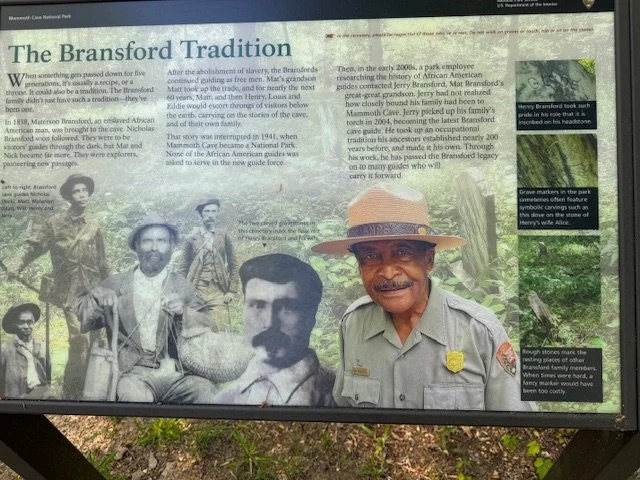
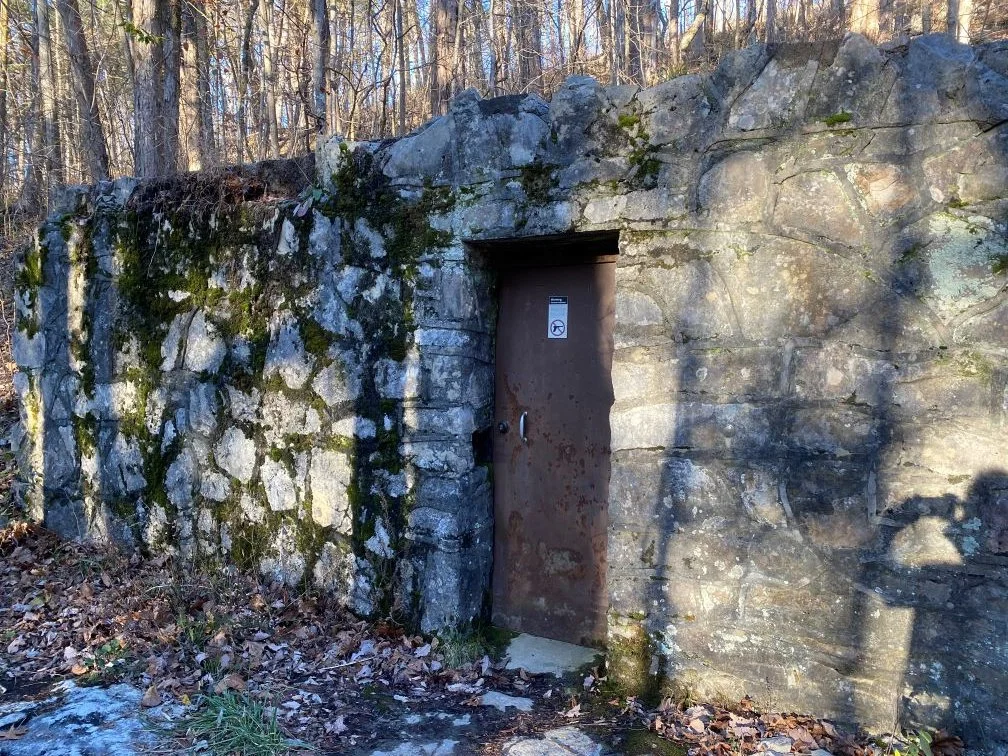
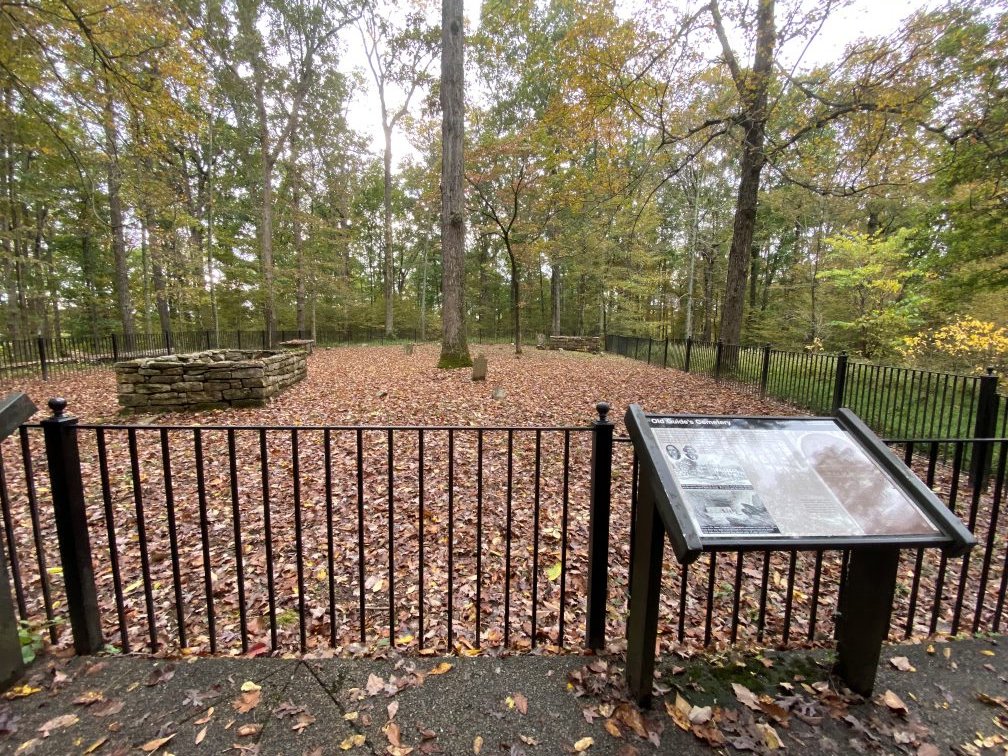
Which is why I was utterly surprised to learn that photos of the monument and the sign appeared in the database of files “Flagged for Removal” according to S.O. 3431. If you want to learn more about what this means, and how it works, I have an entire blog about it. But the basic summary is that last year, (March 2025) The president issued an executive order that National Parks were no longer allowed to hurt his delicate feelings, and in response Doug Burgum, Secretary of the Interior issued Secretarial Order 3431, which was disguised as measure to update and repair park signs, but is mostly just a way to filter out any information the party deems unfit for public eyes.
Again, read the previous blog. The point is that the 3rd section of the 3 part request asked park employees and tourists to report any information in a park which doesn’t focus on the Beauty, Abundance, and Granduer of Natural Features, or which is ‘unnecessarily negative about American’s’ past or present. The asinine nature of the environmental part of the order will be covered in a future section. I don’t think anyone is going to make the argument that the focus of the Bransford Memorial and Monument in Mammoth Cave are related to natural features, (or repair or informational updating as they are new and in good condition.)
Instead, the reason the monument, the sign, and talks about the Bransfords and other Black families in Mammoth Cave seem to have been highlighted as part of S.O. 3431, is because of the clause about being ‘negative to American’s past and present.’ And yeah, if facts can be disparaging, then the fact that men were enslaved is pretty disparaging to the people who enslaved them and the system that made that possible. The fact that the tour guides who lead people into Mammoth Cave and were responsible for their safety and entertainment couldn’t take the same tours, share the same lodging, or use the same restrooms above ground, because of the color of their skin is pretty disparaging to the people who enabled and participated in the system of segregation long after the end of the Civil War.
The fact that people, of all race and creed, were forced out of their homes, and off their land when the Mammoth Cave National Park was formed does highlight a negative impact of National Park formation. And it’s incredibly negative that guides who had, for generations, led tours in Mammoth Cave, were not allowed to return to the job, simply because - according to the regional director at the time- thier skin color did not fit inside a National Park Service Uniform.
So sure, that is all negative. But it is also fact. And facts are sometimes disparaging. Also, in hiding, or hiding from facts negative like this,* there is a much more negative outcome. Removing these stories from public view, stopping talks about this aspect of our history, and editing out the most negative aspects of this part of our parks is also incredibly disparaging to Americans. The Americans who lived through these times, the Americans who were resilient throughout. People, like the Bransfords, who found ways to thrive despite the challenges. Their stories deserve to be told, because stories, like those of the Bransford Tradition, are integral parts of National Park History, Just as stories about the challenges, the highs, and the lows of our country are integral to our history.
*(Also, most of the highlighted signs in the folder containing submissions from Mammoth Cave don’t even mention anything negative, and none of them dwell on those negative. The stories are mostly presented from the framework of challenges being overcome, or people exceeding the expectations attempting to constrain them for their time.)
Our National Parks were and are established to preserve and promote our natural and human history. And should be there to provide not just recreation, but also information. And not all of that information will be positive. The most important aspect of that information shouldn’t be a positive glowing review of historical actions, but instead an accurate, representative, attempt to explain and contextualize our past, so that we know about the places we love, so we can love them deeply, and not just for a thin and fictional veneer. And we should be open to learning even more about them, even if it includes negative aspects, so that more family histories, tribal traditions, and stories of resilience and legacy can get their monument, memorial, talk, or hike. Because that’s one of the coolest thing about our national parks. They exist to protect and preserve, but new stories are happening in them all the time, and old stories can always be given new light.
Small walks to memorial cemeteries might not be the highlight any National Park would choose to feature, but given the right context, they can be as valuable to a park as as a 4oo mile long cave. And there should be more of them, not fewer. And removing them, simply because some of the negativity might hurt someone’s feelings, should be considered nothing but an embarrassing blunder.
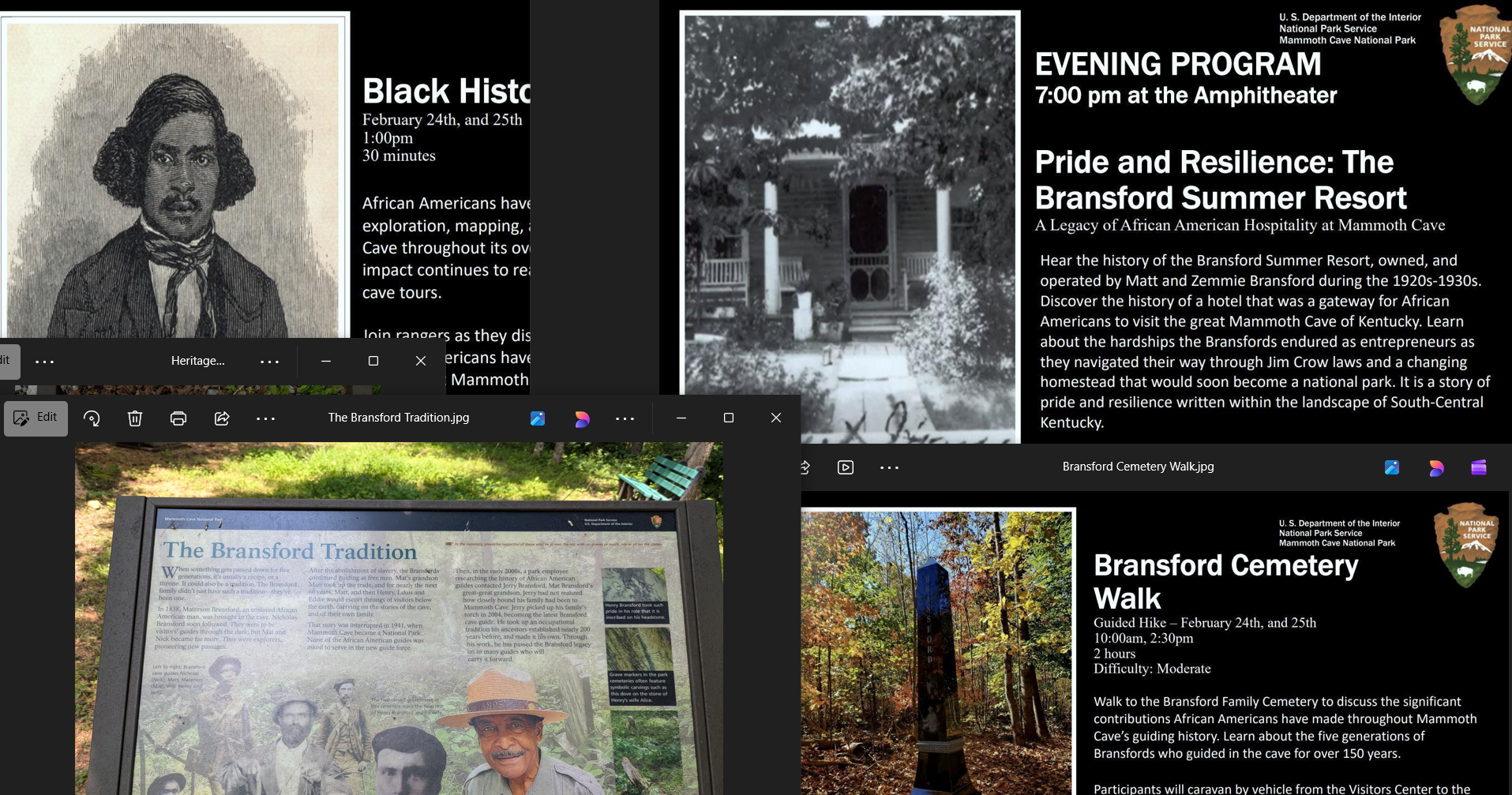
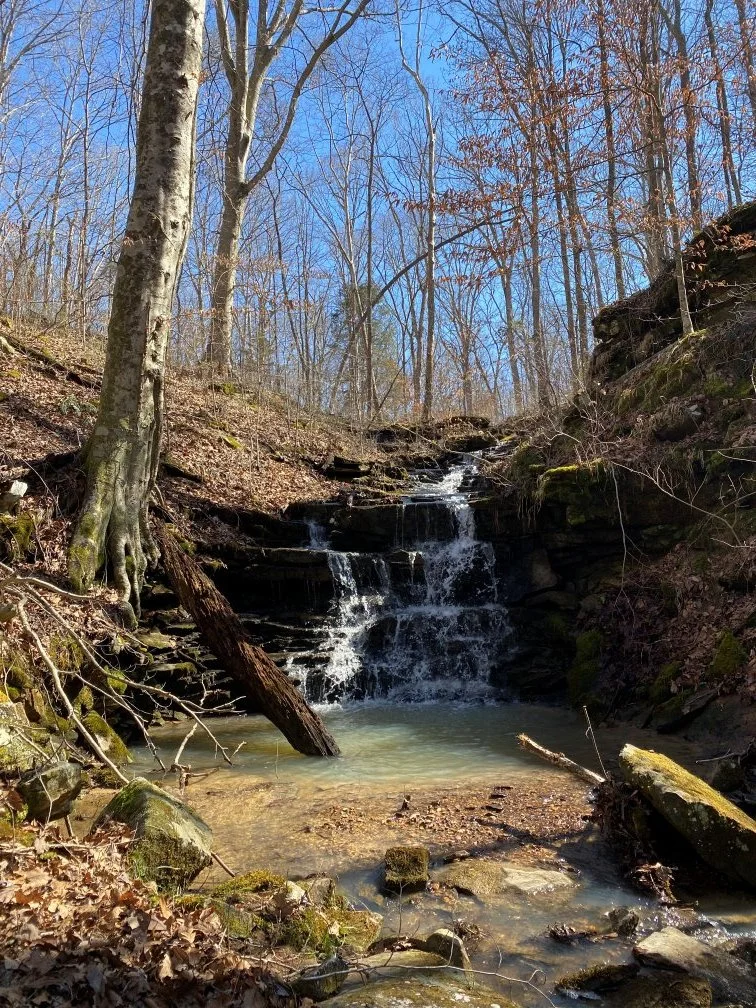
Above is representation of the files from Mammoth Cave flagged for Review.
Now. The internet database titled “Flagged for Removal” Contains files submitted from many of our national parks. There’s an excel spreadsheet which is purported to instruct some parks on the actions which should be taken in regards to specific park media. And that does, sometimes, include removal. However, while there were ~60 files submitted about Mammoth Cave, (including, the Bransford Tradition sign, A Bransford Heritage Talk that went out to the Bransford Cemetery, a Brochure on the Bransford’s of Mammoth Cave and many more,) the file contains no indications if any of the Flagged Media is set for removal or censorship.
What will happen to the media at Mammoth Cave is an open ended question.
But, honestly, having looked through all 60 files, (and many more in the database featuring other parks,) it’s utterly absurd that it’s even a question.
So, what should we do?
First, recognize the results of expertise, hard work, and years of dedication.
Media in National Parks doesn’t magically appear. It’s written by people who know the parks, and sustained by people who know and love them. Rangers and historians interview people like Gary (the hiker who helped me,) and the Bransfords. They dive through historical documents. They compile old research papers. They cooperate with their peers. And everything they produce is already heavily scrutinized. Any sign you see, brochure you pick up, or webpage you read, while on the trail, in a visitor center or visiting official NationalPark.gov websites, is the product of many experts researching, writing, cooperating and correcting, to make certain that the official material is both accurate and representative to the truth of the parks. So, the idea that this material should be edited or censored on a whim, just because some Secretary in his feels doesn’t want people exposed to negativity is frankly more disparaging to the emotional constitution of the average literate American than 99% of the media in a national park.
Second, keep an eye on the media which has been flagged,
Good news. If you’ve read this article. If you’ve clicked the links, your already doing it. History cannot be erased or removed entirely as long as it is known. And so long as the media continues to get scrutiny, and views, perhaps watchful eyes can prevent attempt to change the media which is presented. So, learn more about the parks you love. Take pictures of the signs. Talk to the rangers. Let them know that the history is being seen and appreciated, even the ‘negative’ parts.
Third, share interesting park facts,
Even the negative ones, especially the ones which you might intuit hurting the feelings of certain thin skinned people in power. The more the important history of our parks gets out, the less likely they are to attempt to change it. Already, there have been denials from the D.O.I. about what the database of flagged material represents. And, considering some of the signs were already removed, (as instructed in the excel document,) I don’t necessarily believe them. However, whether all of the files in the database were flagged for removal or not, whether further review would have found many of the signs innocent, if people are reading them, sharing them, and storing them, then perhaps they will note the continued scrutiny and keep the signs they should.
Fourth, keep up with the news, and share stories
I didn’t know that the Bransford signs, brochures, and talks, were part of the list. I find it utterly disappointing that they are but fortunately the Courier Journal, and several other News Sources have been reporting on the story. Keep an eye out, and be ready if it happens too, it will help you be more effective with #3.
You don’t have to do all of these with every park. Choose your favorite, (or a couple) and keep up with them. Find the stories those parks have to tell, document and share them. And most importantly remember 1 simple fact: Our parks are cool, and they are definitely worth fighting for.