
My Favorite Underrated National Parks
There are 63 National Parks. There are more than 450 National Monuments, Preserves, Battlefields, Historic Parks, and parks with other designations. There are more than 100 Alternative Histories and Parallel National Parks which are easily accessible through recognized trans-dimensional portals, and countless others reachable through less well known means. (These numbers haven’t even scratched the surface if we include un-parks, Naltoin Arpks, pseudo-parks, Potential Parks, and ^^^^ (untranslatable in any human language.)
So, each year, I like to dedicated at least one article to highlight some of the lesser known, but still incredible, National Parks.
This year I’d like to highlight three of my absolute favorite and one park which which is often discounted because of it’s underappreciated prime-world counterpart.
#1. Inverted Canyon National Park
Nestled in a forgotten corner of the Southwest Inverted Canyon National Park is the product of millennia of deposition. As the Nahlorado River slowly twisted and turned across the open desert plain, it slowly and specifically left traces of sand, silt, and dust in it's path. These sediments collected in layer after layer building up into monumental structures resembling the opposite of the San Juan Goosenecks. Activities at the park include mountain climbing and rafting, and with the Las Arugulas Falls and the hastening pace of the river, the adventure has been likened to “Nature’s First Flume Ride.”
History and Science:
Early Western Travelers encountered the river and canyon frequently on trips out west, but often got into violent confrontations with aggressive mobs of sedimentary geologists who claimed the natural structure was “impossible.” It wasn’t until Geologist Matthew Cope Marsh was exploring the area in his quest for the ‘tastiest’ claystone, that the geologic formation was accepted by modern science. Physicists ascribe the counterintuitive flow of the river to the top of the canyon like this: “You know those novelty shops which make use of visual tricks and illusions to convince you that cars are rolling uphill, or the room is upside down, or you’re standing on a flat surface when it’s really a slope? We think it’s something like that.”
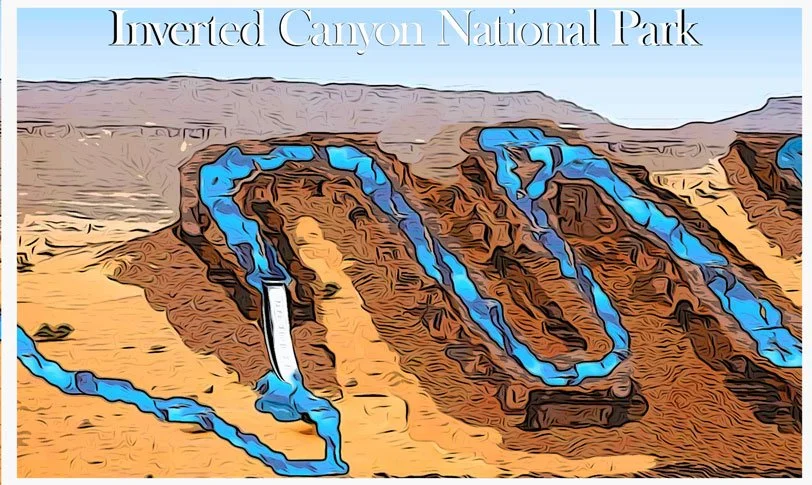
Est: 1903
Wildlife in the park include the Trison, a giant three-horned bovine. Almons, rocky freshwater fish who spawn upstream then migrate to cities to take office jobs when the mature only to return every 5 years to spawn and die. And the elusive Riverfloater, a relative of the roadrunner with heavy fat stores which allow them to raft up and down the river harvesting fish.
#2 Alternate History National Park #53: Mt. Slowabit.
Alternate History Parks are always hit or miss. Some realities are so painfully depressing that their standards for preservation and conservation are way off from our own. Oil Fields National Park, and The Choking Fog National Historic Preserve being the two most obvious examples. Other’s are so similar to our own national parks, that they are hardly worth parallel portal travel and transition to a separate plane of existance. Who wants to spend all that extra time, and experience the warp pain just to see “the Grand Canyon but 2 inches deeper” or the Never Ending Glades? (The Never Ending Glades are just the Everglades in a world where contractions are never used to make proper nouns.) But some Alternate History National Parks hit a satisfying balance between different and familiar which allows them to be suitable draws to visitors from across existences. And while it is never the park with the biggest history or the grandest vistas, many of the alternate history takes on Mount Rushmore are distinctive enough to make the travel worth it.
The monument to western heroes is interesting. The monument to local indigenous leaders is, perhaps, the most informative. But if I had to reccomend just 1 version of an alternate Mount Rushmore. It would be Mt. Slowabit.
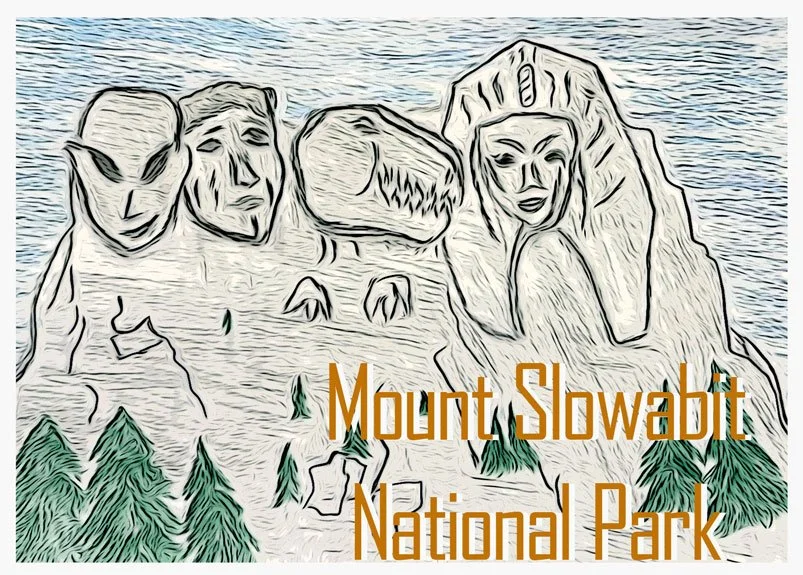
Exl’gorph, Marcus Leapus Andromecus, Paul, and Hatshepsut IX
Designed by Bruton Corgiglum, initial plans were to honor local eastern heroes. Men and women from the wild west who fought couragously to return to their more comfortable lives on the developing east coast: Anne Timbers, Cowpoke Willie, Johannes Brahms, and Merman Helville. However, these plans fell through when he could not get the funding, so he thought about honoring several of the U.S.’s greatest presidents. When he realized that none of them were all that great, he turned instead to the long legacy of America, figures which trancend history across all planes of existance, people we, even over here in the prime dimension should recognize.
Exligorph, who needs no introduction nor explaination. Marcus Leapus Andromecus, the first Roman emperor to discover Montana. Paul. And Hatshepsut IX the pharoh of modern Ancient Egypt who entered into trade negotiations with the Haudenosaunee, also known as the Iroquois Confederation during the Second War of 1812, (which happened in that world’s alternative 1819.) The name comes from a peculiar incident in 1884 when Charles E. Rushmore was surveying the Black Hills. He asked his local guide if the mountain had a name, but he he was speaking so rapidly his guide asked him to Slowabit (meaning his speach.) Confusing the phrase for a local word and name, he marked it on the chart without second thought.
Tourists can visit the monument by traveling through parallel portals 64 or 93. It’s advised to follow the signs to the monument and not stray off the main highways, due to an ongoing langolier infestation. (Major highways should be clear, but do not let passengers sleep if driving through a rainbow.) This particular alternate world has a flavor of ice cream called Blue Marble which is especially delightful and can be purchased at Paul’s Cafe near the entrance station.
#3 Shark Cave National Park
When Sheriff and soon to be amateur Spelunker Martin Benchley went to rescue his teenage son and his friends, he didn’t realize he was diving into one of the most fascinating places on Earth. A sinkhole had appeared one day in the middle of Amityville Ohio, swallowing the teenage Benchley and several other members of the high school tennis team. Sheriff Benchley was expecting the worst, but he did not foresee the massive complex of tunnels he would discover winding beneath the city. Even more remarkable: the vast underground river running through those caves. Rushing rapids pouring over stalagmites, long oxbows meandering through massive caverns, deep pools of crystal clear water with only traces of a current.
What he also could not have foreseen was the incredibly unique forms of life which had made the cavernous river complex their home. Fortunately for Benchley’s son and his friends, they had landed in one of the vast pools beneath the new cave entrance. Unfortunately, the predators which called those depths their home quickly recovered from the startling collapse of the roof of their world.
Eyeless from years in the dark, they navigated using a heightened version of an electrical current sense, and although they’d been scattered by the falling rubble, they were now using it to approach the new prey meatily thrashing in their waters. Martin Benchley was able to pull the teens from the pool, one at a time sending them up the rope while he balanced on an inflatable ducky borrowed from the nearby public pool.
He was the last one out, but he told everyone of the dark shapes he’d seen beneath the waves. Of course, the mayor didn’t believe him, and soon efforts were underway to turn the Underground River Complex into a summer sensational spectacular, drawing tourists from far and wide. Of course spelunkers far and wide were salivating at the possibility of a whole new undiscovered cave to explore, but they would have to wait.
The Tennis Courts were city property, and the city wanted to make a profit, so they began the summer season by opening the main cavern to capitalize on the early headlines, and accommodate the influx of curious tourists. A stairwell, a modified elevator, the ‘worlds only underground beach’ and even a set of paddle boats people could take into the heart of the main cavern. They’d places a line of floats blocking off any deeper exploration.
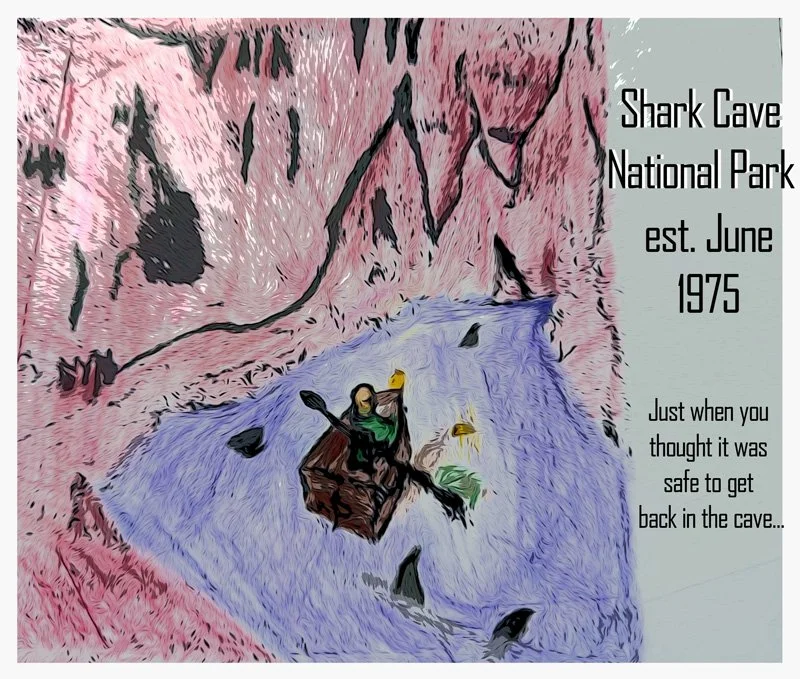
Defying expectations, Cave Sharks are did not evolve cave albinism, instead opting for a sleek grey which makes for better (more recognizable) postcards.
The construction kept the monsters at bay, but despite the sheriff’s warnings, (and the words from a few of construction workers who saw shadows in the depths,) the mayor pushed for a grand opening. Things went well, for a couple hours, but then hunger and instinct took over, and a school of sharks emerged from the depths to commit a frenzied attack. Several tourists were eaten, there were more close calls, and a new species of shark was discovered: Carcharadon troglodytus. The Cave Shark.
National headlines were made, a mayor was deposed. A Sheriff was vindicated, and a National Park was opened. . . After a series of circuitous events and a poorly thought out shark hunt. Fortunately cooler heads prevailed and now the area has been set aside for the preservation and exploration of a massive underground underwater ecology.
The sharks are only the start. There are cave coral, cave shrimp, cave langoustine, rock lobster, and entire families of crabs which are constantly cleaning. However, because of that early disaster, the Cave will always be known for the shark population which came as quite the sudden shock. Tours continue, exploration is ongoing, and you can visit too, but you’re gonna need a bigger boat.
Fortunately not that big, the max size of the Carcharadon troglodytus is 6ft. But they’re still incredibly scary.
#4 Saint Joseph Helix National Park.
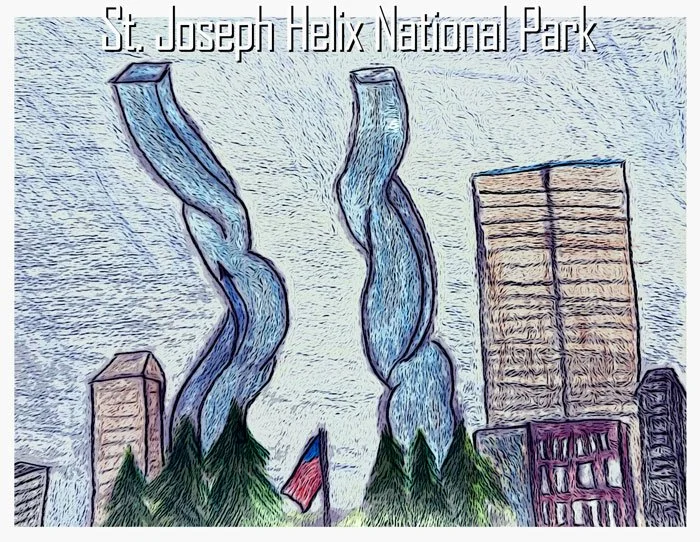
While Gateway Arch National Park in St. Louis Missouri is the smallest of the 63 National Parks, and is often outpaced in terms of history, scenery, size, wildlife, and wonder. It does have it’s charm, and every park is someone’s favorite. But my favorite version of this type of park is Alternate History National Park #17, nestled on the banks of the muddy Mistyslippy River, the Town of St. Joseph was once the gateway to the South (in this alternate history everyone is Canadian, and they had a southward expansion.)
Originally inspired by a brief glimpse through portal #26, Neero Saurine saw our St. Louis Arch and said to himself, “I can do better.” Initially his plan was to mimic the newly discovered structure of DNA, the concept turned into 2 distinct bendy towers because the architect was using an earlier model published by Dr. James Michael Creeth.
The towers were never conjoined however, as his proposed bridges of Aluminum, Chrome, Gold and Tungsten, representing the 4 nitrogen bases were deemed far too expensive, and also structurally unsound in most combinations.
I find it to be a whimsical alternative to the familiar.
Accessible through parallel portals 17, 21, 26, and 297 – only on Wednesday’s.
As Always, Happy April 1st!