
Digging up a Story
Today I had the awesome opportunity to talk to two different groups of young readers/story tellers, about writing. It’s a pretty simple start to a writing exercise about turning Discovery into a Story. Digging into your interests to make something more interesting.
The audiences were all ages, some too young to read, some too young to write. Some already writers and readers full of their own ideas and questions. The most awesome part of talks like this is confirming one simple fact, everyone has their own great ideas. And quite a few in the audience were way ahead of me.
I got to tell the story of Melissa, a ghost who haunts Mammoth Cave, and both times I gave the talk, there were a few clever voices in the audience who predicted the end of that story long before I could get there. There were also a few voices who imagined a much more awesome stories than the one I told, and I hope that they are inspired to write there version of events.
One of the things that echoed with me, long after the talks were done, were words from the woman who introduced me. Another Melissa, and head of the ACPL children’s department. She introduced the talk with something to the effect of “We all have our own stories to tell.” (Might not have been the exact words, I was too busy prepping for my talk to take notes.)
But that is kind of what I’m hoping to share. There are many reasons to tell a story. And many ways to tell it. (The kids who came to my talk were able to come up with lots of both when asked. “To entertain.” “To share with others.” “To have fun.” "Telling stories.” “Typing Stories.” “Cutouts.” “Drawing.” (And other great suggestions.)
At the end of the day, Telling a story, writing a story, typing a story, drawing a story, making cutouts that tell a story, singing a story, are all ways of sharing a bit of ourselves with others. And we all have something distinct and awesome worth sharing.
And that was the entire purpose of the talk and the exercise I wanted to share.
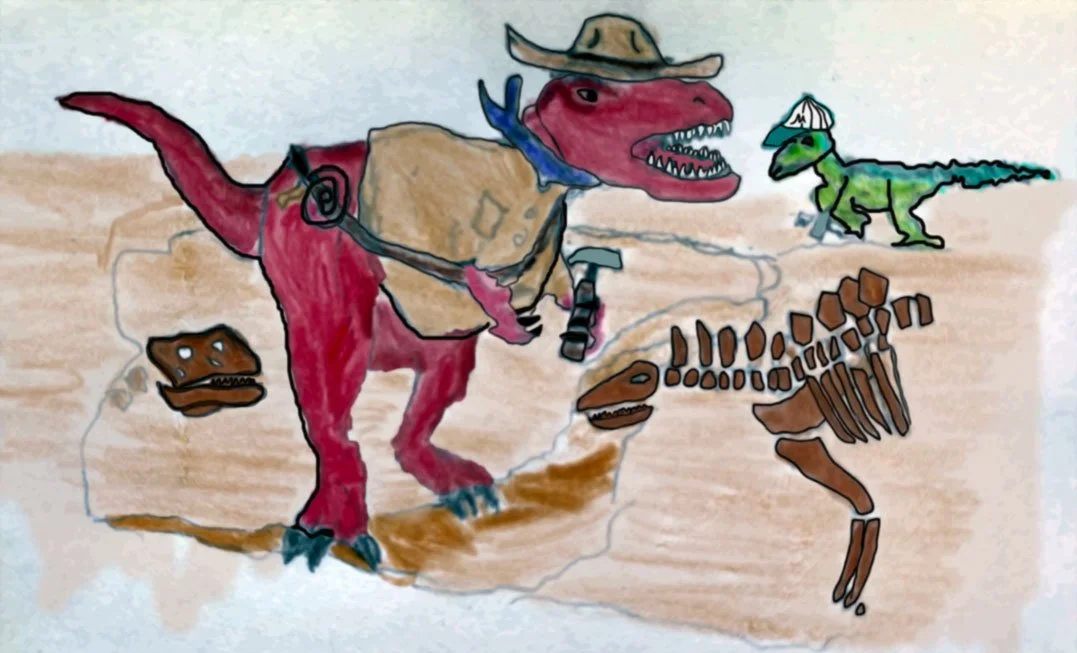
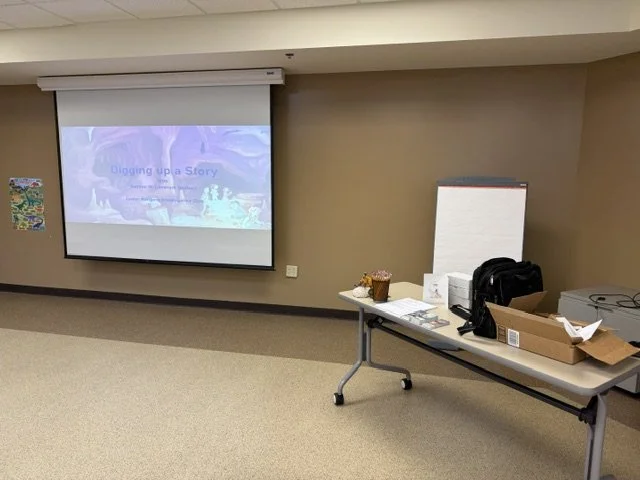
Digging up a Story is really just 3 easy steps:
Discovering Something Cool
Learning More about it.
Fitting it into the story.
I’m not going to write down the whole talk here. (Although I will probably put the Presentation and Exercise Sheet online soon)
But the whole point of the talk, was, very simply that one of the most awesome things any writer can bring to their story is curiosity, asking questions and looking for answers can help you discover entirely new ideas, that you can then share with other people. And, one of the coolest things about writing fiction, is that when you run out of answers, that’s where the real story begins.
So, here is the writing exercise in simple steps.
Step 1: Think of something you’re interested in. (Or something you’ve recently discovered.)
Step 2: Think of all the interesting things other people could ask about it, or questions you still have, and then find as many answers as you can.
Step 3: Use what you’ve learned in a story.
Discoveries can help your story take shape, in many different ways.
They can help you with your setting: the places and times where your discovery makes sense. (Example: An interesting Dinosaur fact can send your story back to the Mesozoic.)
They can be things that your characters know. (Like how, in my stories, Bethany’s always going to know more about Rocks and Books than her friends, because she and I share those two interests.)
And Discoveries can can be part of the central conflict. (A legend about a pirate can turn into a treasure hunt. A ghost story can turn into a mystery about who that ghost was.)
Or, in the simplest and easiest form. You can tell the entire story of discovery.
As an example:
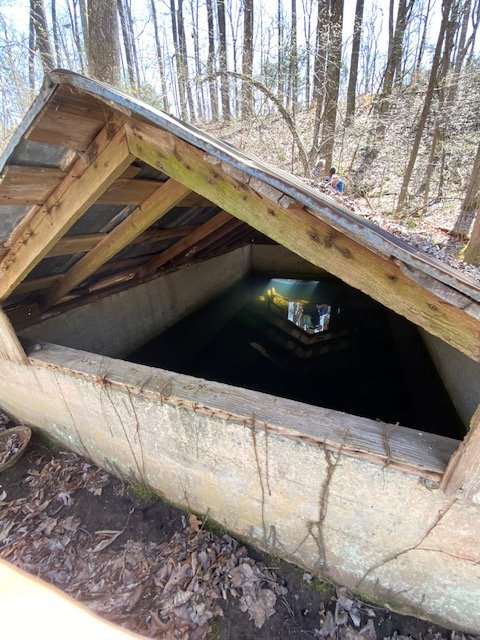
A well in Mammoth Cave
While I was walking through the woods, deep in Mammoth Cave National Park, I stumbled across an abandoned cistern. The simple stone structure was a rectangle about seven feet long by two feet wide. An A-frame roof peaked just below my chest. I had to crouch down to see the water inside. The metal roof was rust stained but solid, and vines coiled up the walls. A layer of dirt, several inches deep and mixed with dead leaves was piled up around the edges. No one would drink from the water inside. It was obvious the structure had long been abandoned, as the trees around it were decades old, and there were no other signs of human habitation, save for a few daffodils known to mark old homesteads.
The path I had taken to get there wasn’t a road, so much as it was a thin trail, covered in dead leaves, and pocked by trees, empty in their winter slumber. But there had been an abandoned car, something that I didn’t recognize, but something which would have fit in the traffic of a movie set before World War Two. It had been parked in the middle of the ‘trail’ about a mile back, covered in dead leaves, it’s engine setting several feet from the rest of the wreck, also far from any modern structure.
Perhaps the two were related. Perhaps not. It was getting dark, so I left the well, and passed the car on my way out of the woods. But I carried questions home with me: Who’s car had that been? Who had once drawn water from that well? Were the two related? And why had they been abandoned? Where there other structures hidden by the trees that had grown, and the leaves they had shed over the years?
The next time I returned to Mammoth Cave, I asked the rangers about the well. The first I spoke with, didn’t know that it was there. The second woman recalled that section of the woods, but shook her head. She had seen it, but knew nothing more. “Lots of old homesteads out here.” A third ranger said. “Many folks had to abandon their homes when the land was bought for the park. The CCC tore most of the old homesites down, except for a few chimney’s still standing in the northern part of the park.
Perhaps that was why I hadn’t seen any other structures. But why had the car been left behind? And why was the well still standing? I tried the local libraries in Cave City, Glasgow, and Edmonson County. There were records of homesteads, of family grievances whentheir land was sold and left behind. But no mention of the car, the well, or that specific property. “The old Carter Well.” Someone answered on Facebook, when I left the message with the Edmonson Historical Society.
But when I asked him why it was called that, or who Carter was, the only reply. “That’s just what we always called it when we went hiking out there with the scouts, years ago.” He promised to get back to me, if he spoke to any of the scouts and if they had any more information, but he never did. “The car though, I don’t know.” The last thing he ever messaged me.
Finally, I took myself back out there, to see if there was anything else I could find. Spring was peaking through, and soon the overgrown road would be impassible, overtaken with green, and thorns until fall cleared it all again. But the air was still cool when I reached the car, and nothing had changed. It was parked in the right direction to be making a retreat from the wild, or a return to civilization before breaking down, and being abandoned forever.
I left it behind, stepping over the remains of the engine, and marched through the trees until I reached the well. The sun was high in the sky, and in the added light, I could see algae beginning to cover sticks and leaves resting in the bottom of the well, detritus it had picked up through the long years. There were also come some carved handles, what looked like the abandoned remains of a wheelbarrow that had been dumped in the well so long ago.
I walked concentric circles around the well, an every widening pattern that took me further and further into the woods. A search done in reverse looking for sign of any other structure. And I was just about to give up, when I spotted a narrow rock poking out of the dead leaves. About a food wide and a foot tall, it jutted up from the ground. A slab white marble, not native to Kentucky, it stood out about 200 yards and behind a hill from the old well. Worn down with time, there was more to the inscription, but all that I could read was a simple name. “Carter.”
When Mammoth Cave became a National Park, many families were forced to leave the homes they’d built in the region. But it wasn’t just homes they’d left behind. It was memories, hard work, plans for the future, and sometimes, important parts of their past, even their loved ones. But although the lands had changed, their stories remained, carried on through the years, and marked in wells and stones.
*(authors note this is a combination of 2 different hikes, and the name Carter is made up for the story.)
It doesn’t have to be complex. But a story of Discover, can be a story, and an adventure, all on it’s own.
So, I hope that you dig up your own stories, too!