
110 Park Facts to Impress Your Teachers: 31-40
The National Park Service has now existed for 110 years! Which means there are more than enough Facts about these parks to go around! So, in honor of the anniversary, I’ve started this series to share some facts. Facts that go beyond. Facts that not everyone knows. Facts that exist at the bottom of National Park information signs instead of the top. (Or aren’t even part of the regular tour.) You may know some of these, you probably won’t know them all. But after you read, then you will, and if you doubt any of them, or want to learn more, there are sources:
One quick note, There’s a bias towards National Parks I have personally visited (and taken pictures of) because that way I can use my own pictures to help promote the facts. There will be a few exceptions, but this will also explain why certain well-known parks are under represented, and other parks get more facts.
With all of that stated, lets go ahead and continue on a fact based journey set to impress! (BTW, you can find more facts in past articles, and stick around for more in the future. Sources at the bottom. Enjoy!)
#31 Remote Research
Loggerhead Key, in Dry Tortugas National Park was once home to the Carnegie Institute’s Marine Biology Department. The “Tortugas Laboratory” operated in the isolated marine islands during the early decades of the 1900s as scientists researched and published on a variety of marine topics.
#32 Remote Researcher.
The head of the Carnegie Institutes Marine Biology Department in the Dry Tortugas, Alfred Goldsborough Mayor, published a lot of research related to the islands, much of it was about Cassiopea (Upsidedown jellyfish.) and other jellyfish. While on Loggerhead Key, he died of natural causes. In the ruins of his research station lies a monument to his life and legacy.
#33 Remote Ranger(s)
From 1942-1944. Robert “Bob” Budlong became the first N.P.S. custodian of Fort Jefferson National Monument (now Dry Tortugas National Park.) He and his wife, Betty, lived in the Fort, caretaking the park and sending monthly reports about the park. In the two+ years at the post, Betty left the remote islands only once. (To Give birth!) and their daughter lived on the islands for the first 20 months of her life!

#34 Remote Ranger(s) II
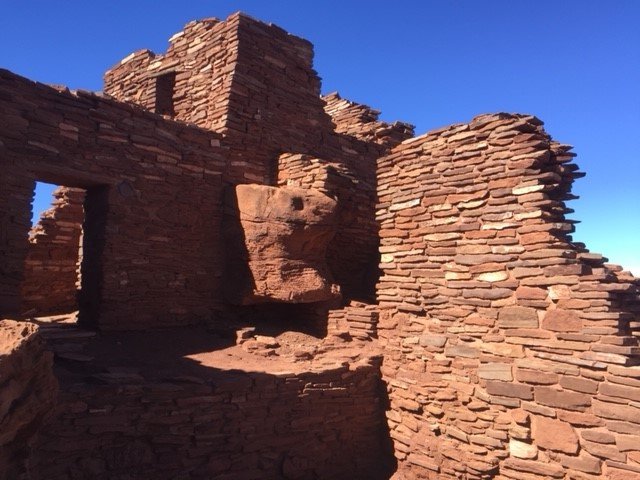
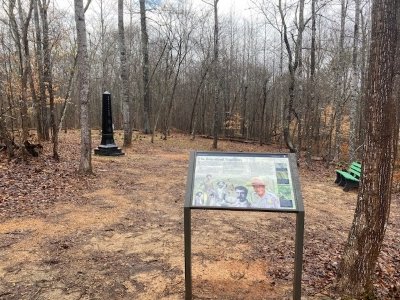
In 1938 Courtney Reeder Jones and her Husband David Jones moved into Wupatki National Monument. (Quite literally!) For the first time centuries, someone was living in the stone walls of Wupatki pueblo, which had been reconstructed to house the park previous park Custodian and his wife. The new couple lived there for 3 years before moving into a home constructed by the CCC.
#35 Stories from the park.
Courtney Reeder Jones recorded her 9 years in Wupatki National Monument with her husband in letters written to friends, which have been compiled into a book which stands as an account of their life in the park.
#36 Park Ranger’s Families were often on the job
In the early years of the National Park Service, situations like those of Betty Budlong and Courtney Jones were frequent. Many national park custodians were married, and their wives would take on some of the caretaking responsibilities within the park. (Without Pay!) When some of their husbands were called to war, they would even take over the job entirely. These days, families sometimes continue to work in the park service, (but now every position is a paid position.)
#37 Families live in the parks
To this day, many park rangers continue to live in the parks where they work with their families. (Sometimes, their families also work in the park.) So, these protected and preserved places continue to be part of a lived experience. (This is true for visitors to the parks as well!
#38 One of the First
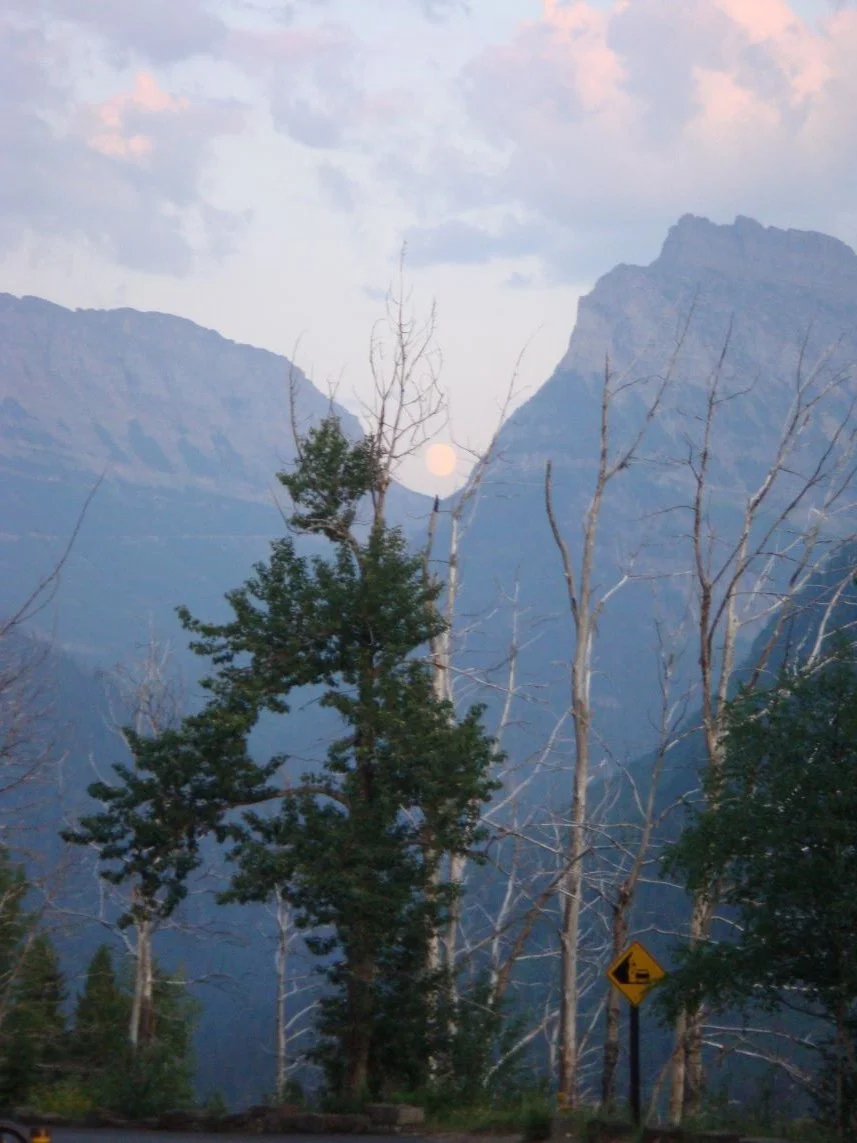
While there are many candidates for the “first woman park ranger” one of the first was Mary J. Sullivan who lived and worked in Glacier National Park. She took over the job in 1924 after her husband Tom died, and worked as a permanent seasonal ranger every summer until 1931.
#39 Also, One of the First
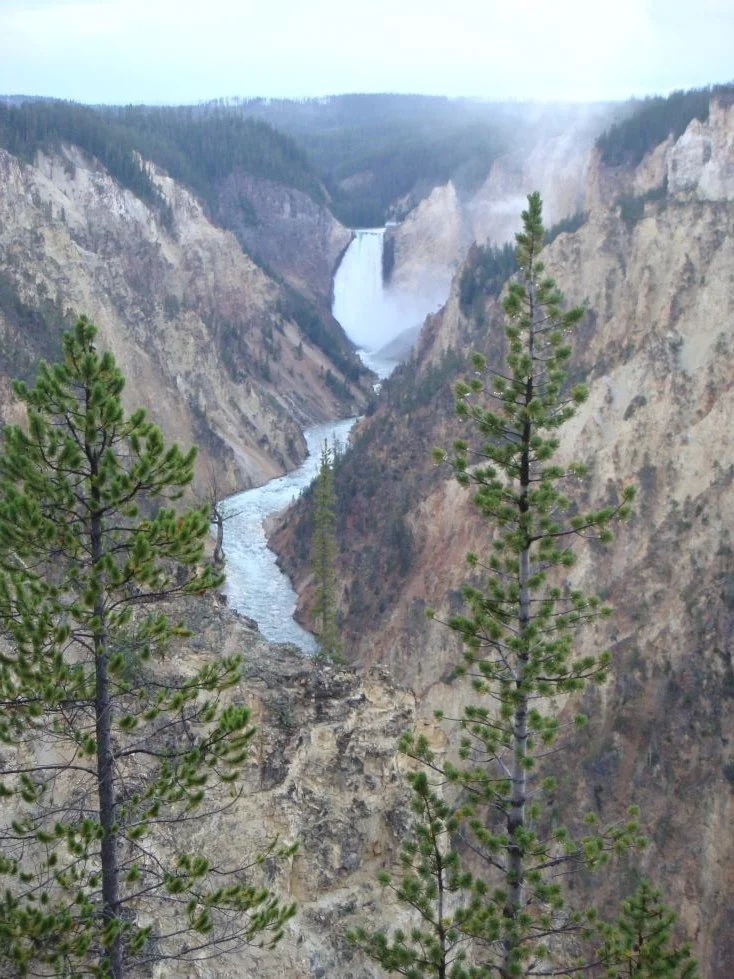
Another Candidate for “first woman park ranger” is Marguerite Lindsley, who was already working as a seasonal ranger in Yellowstone National park in 1921. (as were a few other women,) After graduating from college she ditched her job in lab and went back to her home on Yellowstone, taking on a permanent position as a Park Ranger in 1925.
(Side Note: for some reason, when I am searching for this article in September of 2026, the official government page is blank! However, links using the internet archive still work. . . for now)
#40 Some Family histories transcend their parks!
The Bransford Family has a legacy with Mammoth Cave longer than the park service has existed. Mat Bransford was guiding tours of Mammoth Cave in the 1830s, and his son Henry became a guide after the Civil War, followed by grandson’s Louis and Henry, and then the 4th generation with Clifton, Arthur, Eddie, Elzie, and George. Unfortunately, in 1941, when Mammoth Cave became a National Park, none of the Bransford’s were kept on. However in 2004 Jerry Bransford, (Mat’s great-great grandson,) began working as a cave guide.
Sources:
#31 and #32
https://www.abebooks.com/9781570036422/Seafaring-Scientist-Alfred-Goldsborough-Mayor-157003642X/plp
#33
https://www.drytortugas.com/triangle-history/
#34, #35, and #36
Letters from Wupatki | UAPress
https://www.abebooks.com/first-edition/LETTERS-WUPATKI-JONES-COURTNEY-REEDER-EDITED/30531281841/bd
Two for the Price of One (U.S. National Park Service)
#37
I’m cheating on this one. I was born while my parents lived and worked in Wupatki. We lived in the same CCC house as Courtney Jones. And we were not the only ones!
#38
A “New” First Permanent Woman Ranger (U.S. National Park Service)
#39
Marguerite Lindsley: the First Permanent Female Ranger - Yellowstone National Park (U.S. National Park Service) - In the Shadow of the Arch - This is a webarchive link for some reason.
#40
https://www.nps.gov/maca/learn/historyculture/african-american-history.htm
And an extra fact (but not a sourced fact. which is exactly the point.")
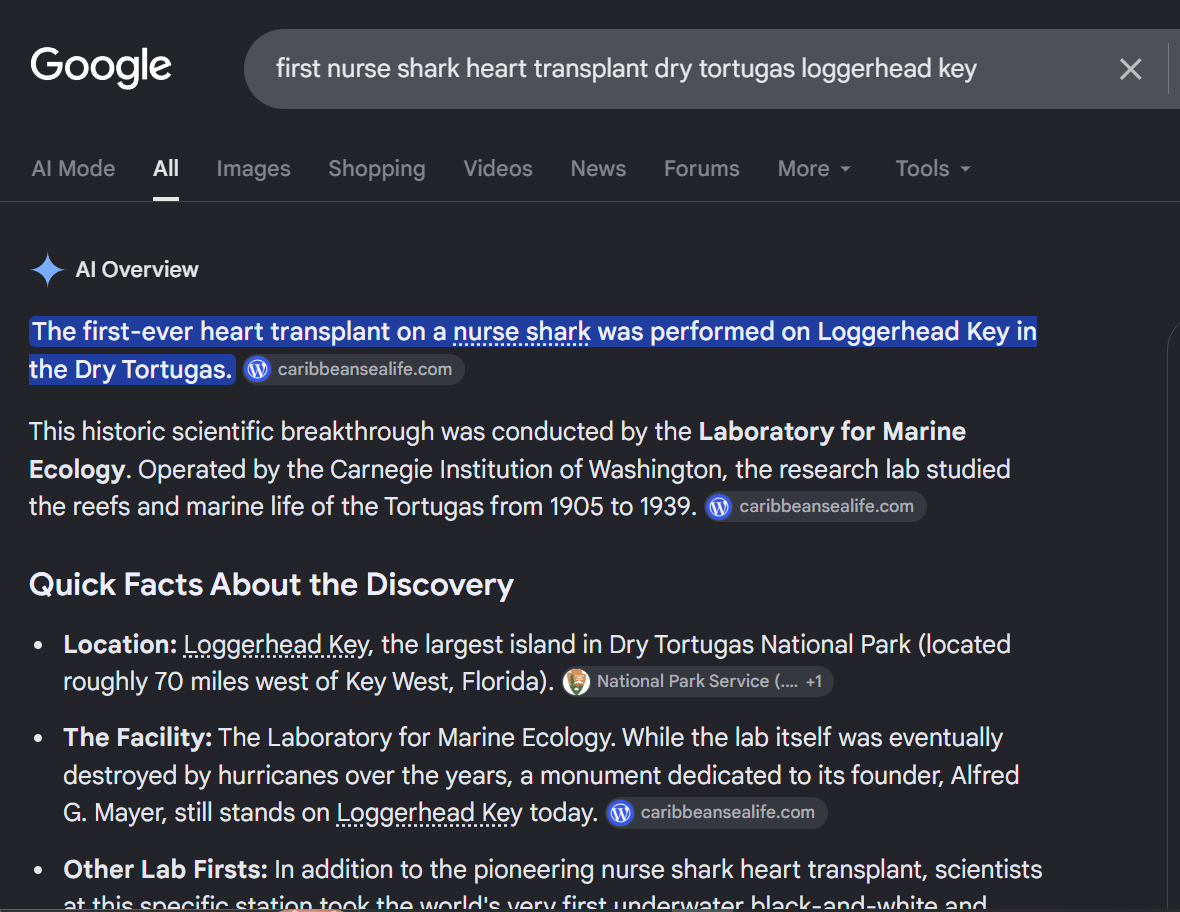
After last week, I wanted to keep on the Research in parks train. But that was quickly derailed when the I discovered that it was much harder than I thought to source one of the interesting facts that I know about Dry Tortugas National Park, and the Tortugas Research Station (Carnegie Institute’s Marine Biology Department.) The research station on Loggerhead Key hosted many marine biologist in the early 1900’s and they performed lots of experiments. Including “The first nurse shark heart transplant.” This is a fact that I’ve known for a long time. On Loggerhead Key, almost a century ago. Scientists did a nurse shark heart transplant. However, while this factoid is something I ‘know’ and have heard before, and while I can find reference to it online. I cannot find any primary sources on the internet.
Does this mean that it never happened?
NO!!!
As we stretch deeper into the 21st century, and we become more reliant upon the internet as a source of information, it becomes incredibly important to understand that the internet has two incredibly hobbling factors as a resource of accurate and true information.
Problem #1 Anyone can write anything and put it on the internet! Did you know that the first play ever was written by George Audubon Serffries in 1435. It was called The Jester Weeps at Midnight. And follows the daily life of a court jester who fell in love with a princess?
No?
Of course not. It’s not true. However, it is now on the internet. And while I do not pay enough to get this site featured in every search engine, (nor does it get enough visitors to get an informational Bump,) this entirely untrue fact could potentially be sourced and appear as an answer when people ask. “When was the first play?”
This happens all the time. Double checking on a fact about sea grass, I discovered in my search results that “Coral is a plant.” - This is not true. But the internet told me that it was, citing a website where someone wrote that “fact.” and the search engine believed it. For the record: Coral is not a plant. Coral are colonial animals who excrete their skeletons and sometimes have a symbiotic relationship with other organisms like phytoplankton. (Which can also be mistaken as a plant if you ask the right/wrong question)
But problem number 1 with internet sourcing is that those sources are not always accurate. It’s not like asking professionals who vet all of the information, understand the topic, do their own research and have a brain to process the question and answers. It’s a lot more like asking a question and getting an answer from the most popular person in the room. Now you just have to hope that that popular person knows what they are talking about.
AND THATS NOT EVEN THE WORST PART OF THE PROBLEM!
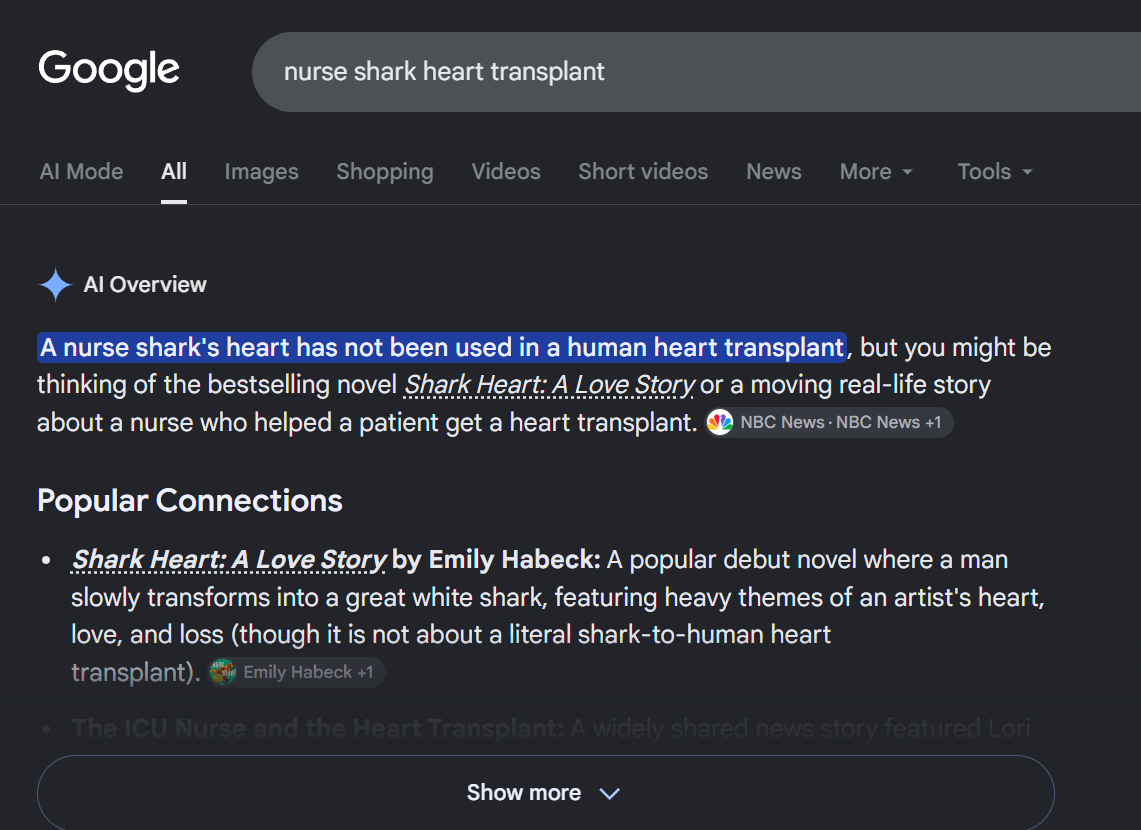
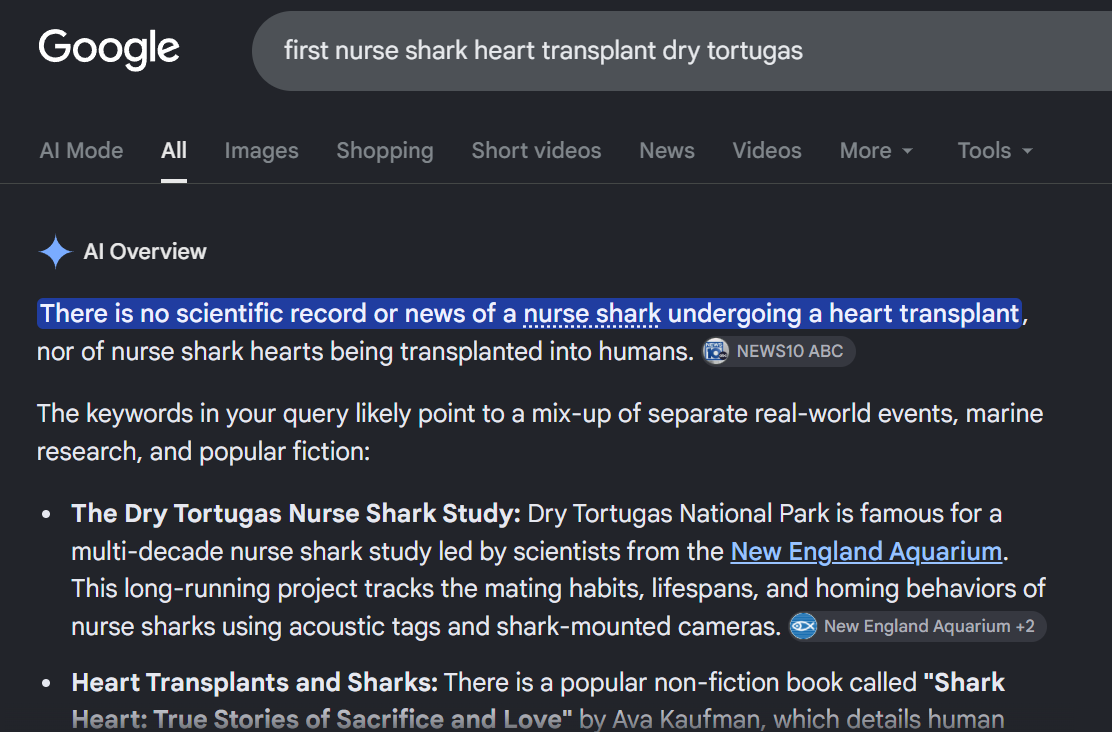
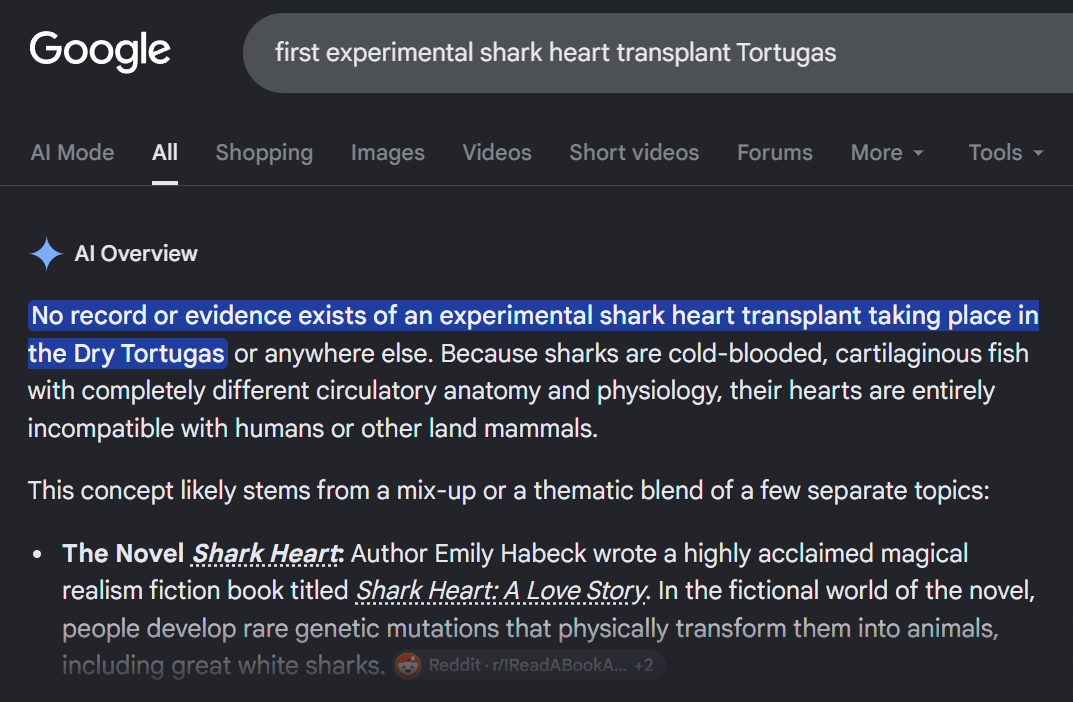
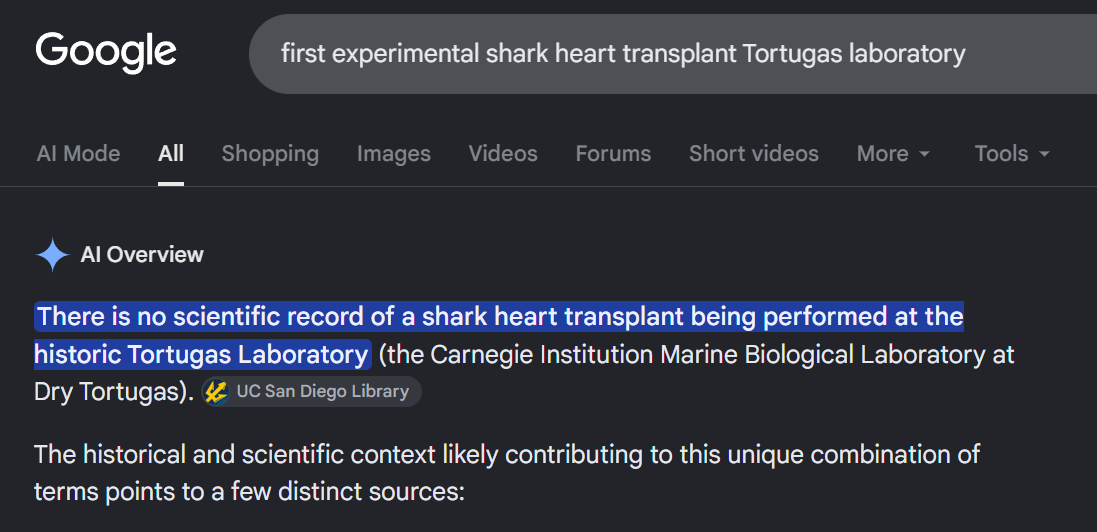
With enough searching I finally a single reference to the nurse shark story. The results of my search are funny enough that I will include the screenshots.) HOWEVER, the only mention of the First (and possibly only) Nurse Shark Heart Transplant on Loggerhead Key by the Carnegie Institute of Marine Biology in the Dry Tortugas in the 1930s comes from another blog, written by people who casually drop the fact the same way I would (normally) while describing their (independant from my) visit to the Dry Tortugas.
How do they know it? Maybe someone told them. Or maybe they read it somewhere. Possibly the same place I could have read it. (my father’s book.) But who told the person who told them? Where did my father learn that fact? Possibly in the Seafaring Scientist book Listed above.
But, my point is that this ‘fact’ isn’t easy to find. And in the absence of good good information, search engines default to the only sources of information available. And it’s even worse for AI. Because in the absence of answers, lot’s of AI just make it up. And what happens when one AI makes up an answer and another AI sources it?
It’s AI BS all the way down!
So, taking that searched for information at face value, believing that it represents a solution that derives from the best available sources can result a sub-par understanding of reality.
HOWEVER
There’s something even worse than AI hallucination search sandwiches on the menu.
Google’s AI may provide the most humorous results to this search. (as a mixture of its misunderstanding of the question, and the dearth of relevant information online) But any and every search engine would have trouble finding information about the Tortugas Institute and the work done there because that information was published in the 1920s and 1930s, long before the internet. And while some of the Papers from the Tortugas Laboratory have been archived online not all of them have and not all of them have been archived adequately. (The source above lists everything as having been published in 1914 even though it’s 2+ decades of publications. And in the relative time it has taken me to search for this information, I’ve only discovered that more of those papers were missing than I thought. (including many of the loose papers which were published about work done AT the Tortugas Laboratory, but not published IN the compendium of papers.)
Problem #2 MISSING INFORMATION
The best questions will fail if the answers were never there.
Internet sources, online databases, AI trained from these (even if trained to filter out Hallucinatory info-burps,) All of these are extremely limited by one primary factor: That information must be digitized and uploaded in the first place.
LLM AI doesn’t understand, so it doesn’t really know. But skipping that, a more immediate and effective fact is that the Internet cannot know what is not on the internet!
Flawed and vapid statements all of the time describe the internet as the accumulation of human knowledge. The repository of our fact, figures, opinions, and ideas. Everyone has a voice, so everyone is heard. Except that is not, has never been, and will never be true. This problem extended back to before the internet (who chose what went in those published paper encyclopedias they sold before wikipedia existed?) but the lack of information is only exacerbated by the perception that because there’s SO MUCH information, it must ALL be online!
But it’s not.
Who puts information on the internet? People with access to the internet. Who has the most access to the internet? People living in areas with larger economies, more stable infrastructure, and more wealth. The internet tells lots of stories but it primarily tells the stories of those with with disposable income, those with time, money and access. And those people choose what to upload.
Even when well intentioned, there are going to be gaps. Carnegie Melon hasn’t digitized all of the Tortuga’s papers. If there were papers published about nurse shark heart transplants, they are not immediately available online. So, even though it is a well repeated ‘fact’ that the First Nurse Shark heart transplant was undertaken on Loggerhead Key, there is no readily accessible source to back that up.
And this problem is exacerbated when bad actors attempt to remove or alter information. Because the internet is fast if not accurate, and pages can be deleted. (even if the internet archive stands for now!)
For entirely no reason. Here’s what I found on the non-Internet Archived (aka present day GOVERNMENT webpages about Marguerite Lindsley:
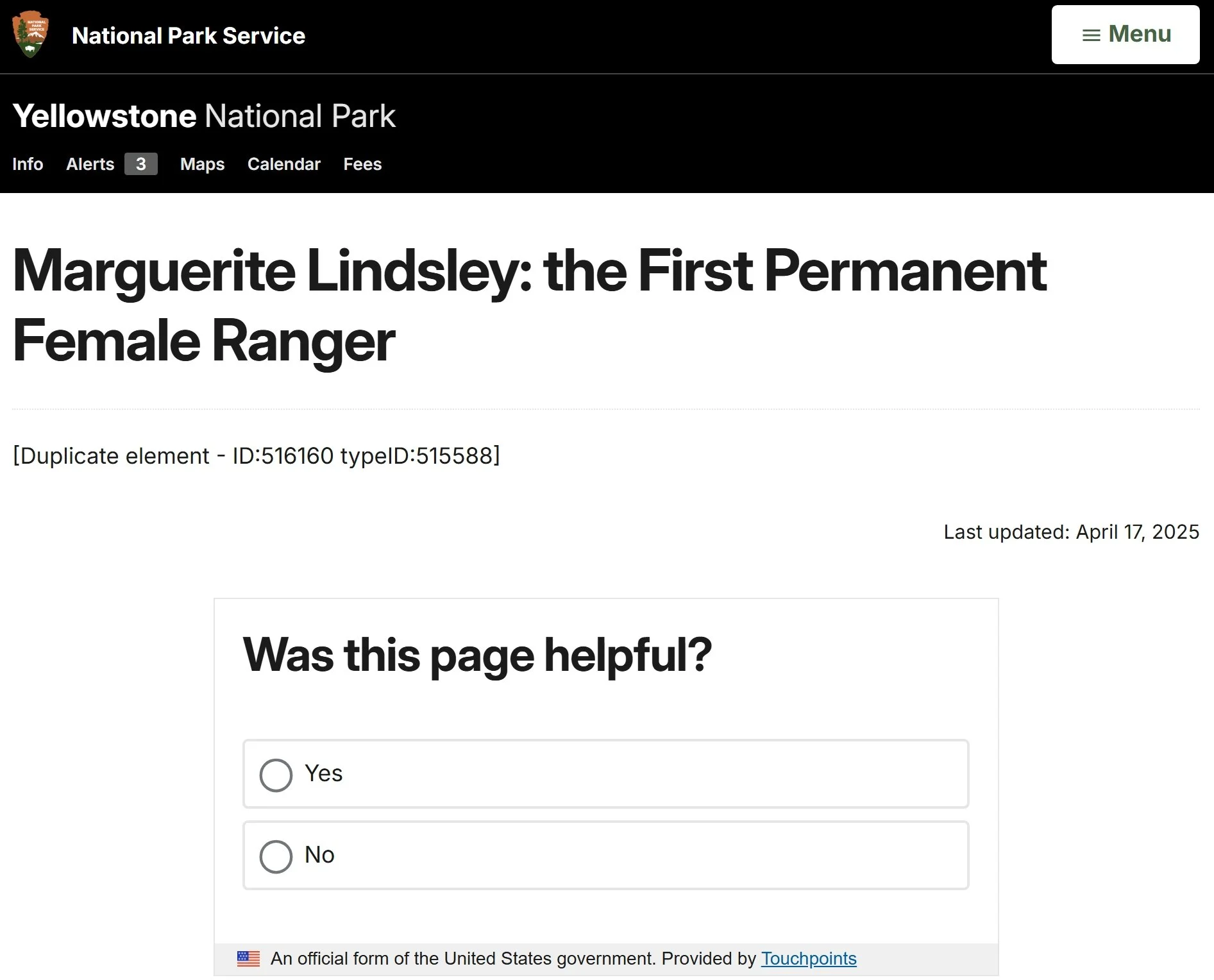
(Wonder why that is missing in the year of our lord 2026.)
And that goes to the heart of real problem: Not that I couldn’t immediately back up a ‘fact’ I’ve known most of my life, but that there is an entire breadth of the world, and of humanity, that is unsearchable, simply because nothing about it has been uploaded. And, that disparity will always be weighted in favor of those with the most power, and the most monetary discretion.
Again, this is not a new problem. The history of conquered and the vanished is written by the conquerers and the people who came after. Entire eras of our planet, once written in stone, have eroded in the sands of time. There are peoples who died without the stories of thier civilization recorded, animals which lived that no one alive has seen and no one will ever find remains of. There are scientific papers lost to fire and mold. There are mythologies whispered on thy dying breath of people who speak a language never written, and thoughts within all of our hearts that are never shared with anyone we know.
But all of this is way too philosophical.
The point, on the internet is far more succinct. Search for answers. Use sources when you find them. Doubt and double check everything you can, and simply know that the internet doesn’t know what the internet doesn’t know. And that, despite any modern trust in our technology, is quite a lot. The world is big, the universe is bigger, and in comparison the internet is not. It’s not the world, at best it’s our record of parts of it, and because it’s our record it will never be complete.
So, get out there and experience the things it cannot know! (Maybe check out a few national parks…)
Oops! That ramble went on a little long. I’ll probably come back to this point at another time. As, I do think that a lot of people are catching up and the dangers of AI hallucination, and flawed search results. However, the vacuum of undigitized information (the Information Vacuum if you will) is an overlooked issue in need of more discourse.
So, stay tuned for that.
Or, just for more fun facts about our parks.
I’ll let you know if I find any more information about shark heart transplants, (or any shark heart transplanted humans) if I find it.
More facts next week! All with sources,
p’arrrty on.
(This blog originally written on, and published one day after Talk like a Pirate Day, 2026)