
110 Park Facts to impress your teachers: 41-43 (1st Haunting Edition)
So, you know a little, or a lot about our National Parks? How about a little more? Rules are as follows: 110 facts for 110 years of the National Park Service. Each fact hopes to delve a little deeper into every park, you might know some of them, but hopefully a lot of them will be new and surprising. All of them will have sources at the bottom if you want to know more.
This month, spooky month, I thought we’d slow down. So, we’ll explore fewer facts, but we’ll explore them more entertainingly. They are sourced as always, but there might be a bit more narrative to this flow. This week we will discuss the ragged lines, the rotten hulls, the rusty blades, and the salty rumors of maritime apparitions, with facts about Ghost Pirates, Ghostly Victims of Pirates, and high seas ghosts of dubious origin.
#41 Ghost Ships of the Everglades:
On a foggy night, the bright light of the full moon cuts through the mist, exposing an approaching shape.
Rotten hull, battered masts, slack lines, and wind torn sails. A ship emerges from the fog, unfit to sail but drifting ever nearer. On deck, a skeletal crew marches. Their solemn parade is a dread mockery of the actions of the living sailors they once had been. The only sail untouched by time, death, and decay is the flag furled over the crows nest on the mizzen mast: a black sheet marked with the skull and crossbones. Behind the wheel on the aft deck, their dread captain turns his head, an imitation of the skull on the flag, capped with tricorn hat. His eyes bore through you, looking on, and before you can react the ship is gone, lost again in the fog, returned to it’s endless futile search for the sea.
You, aboard your kayak, release the breath you’d been holding far too long, and dip your paddle back into the water, skimming the edge of the seagrass marsh, you wheel your boat about. Best not to follow that ship, for they have been cursed to sail the Everglades forever looking for an exit and never finding it. Theirs is not a path you should follow.
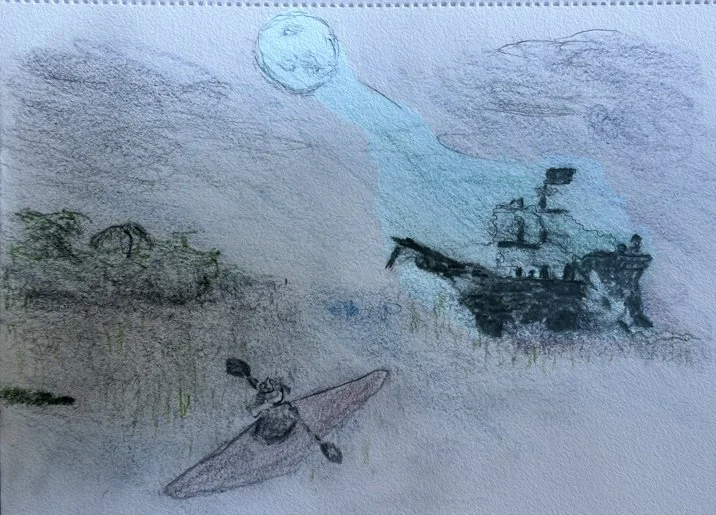
Some version of this ghost story has been told for over a century. A pirate crew, their ship carried into the marsh, lost and unable to find a way out, starves to death, or dies in the toil of escape. Yet, although they perished, their souls carry on, sailing thier vessel, still looking for escape.
In one of the earliest versions of this tale, (an article published in several papers in 1901,) the pirate crew assailed a merchant vessel, and forced all the sailors to walk the plank. The captain’s wife, watching her husband sink into the depths, called forth a curse, and both vessels were swept up by a tidal wave, carrying them miles into the Everglades. The pirate ship was deposited in a body of water deep enough to sail, and sail they did, following the currents and hoping to reach the sea. However, they never escaped the swamp. Whether their vessel was stranded upon an embankment, or trapped in an endless snarl of water with no way to sail out, the ship was snagged and the crew was trapped with her, starving to death, or succumbing to the elements.
As the last breath of the last sailor made it’s final escape, the crew was not as lucky. The ship continues to sail on looking for a way out of the Everglades, but the crew aboard is cursed never to leave.
Some people visiting the Everglades report a ghostly sailing vessel appearing in the twilight hours of dawn or dusk, or on the edge of an incoming fog, and they attribute these sightings to the ghost story above.
Or to the other version of the tale:
The pirates were pirates still, but their reason for sailing near the Everglades is a well-documented real-life phenomenon. Many pirates used the shallow waters of the Florida Bay to escape pursuit, because their ships often had shallower drafts. That meant that they could escape from heavier navy vessels which would run aground in the same water.
Supposedly, in the early 1800’s, as U.S. navy vessels were hunting pirates, one such vessel sailed into the waters of Florida Bay to escape capture. They hid out in the mangrove islands and channels which decorate the southern tip of Florida, attempting to lose or wait out the navy vessels after them.
And it worked, after several days had passed, the navy ship, unable to find a path through the shallows, disappeared from the horizon! However, before the pirates take advantage of their newly won freedom to escape, a storm blew in! In the days before early warning systems, the hurricane took them by complete surprise, and the howling winds and raging waters carried them over the mangroves and into the marsh. In this version of the tale, however, the pirates were not fortunate enough to be left with an intact ship, and their vessel was wrecked in the Everglades.
The surviving crew was stranded inland, in the shallow mash, miles from the open sea in a shipwrecked boat and hundreds of miles from any civilization known to them. (The indigenous peoples living in the Everglades would probably have kept their distance.) Some sailors chose to stay with their wrecked vessel while others decided to brave the sawgrass marsh, and the cypress swamps beyond in hope of escape. But neither tactic would save them. The pirates died off due to starvation, sickness, swarms of mosquitos or encounters with alligators, few, if any finding a way out. (how did this story come to be if none of them survived?)
Death was not the end however, and the men were drawn back to crew their wrecked vessel. To this day they still sail the waters in and around the Everglades, haunting the waters which claimed their lives.
Is either version of this story true?
The next time you’re out rowing through the Everglades on a full moon night, and you encounter a ghostly vessel, why don’t you row up to it, and ask the dread men aboard?
#42 The Ghastly scent of Coffee on Elliot Key.
Ghostly Legends surround a pirate named Black Caesar. There are, at least, tales of two similarly named men. One is of a pirate from the 1700’s, a contemporary and supposed partner of Blackbeard. The other is man who came at the twilight of the legendary pirates, and faded with them into legend in the early 1800’s when the U.S. Navy and other powers began to hunt down the freewheeling rogues in the Carribean.
This story could be attributed to either, but is more befitting the earlier pirate named Black Caesar, and seems to come from some of the embellishments to his legend. I’ve discussed both of these men in other places, and the questions about their stories. So this Britannica summary will give you more than is necessary for this tale.
Black Caesar became a pirate after being captured and escaping from a sinking slave ship. He befriended a sailor aboard the slave ship, and the two escaped on a life boat when the ship was sunk in a storm. They found themselves in the Florida Keys, and set up a refuge, surviving until they spotted another vessel sailing a similar route in the now calm waters. They hopped aboard their lifeboat, raising the signal of distress, but when the vessel came to their aid, instead of accepting rescue, they drew weapons on the crew and looted the ship!
Thus did the career of Black Caesar, and his partner, start. Setting up base on Elliot Key, (now in Biscayne National Park) the two men would pose as shipwrecked sailors, and pirate any vessel which came to help. Eventually, they amassed enough wealth to attract a full crew of pirates, and an actual pirate vessel. Somewhere along the way, there was a falling out, and Black Caesar killed his former partner.
He and his crew maintained thier base on Elliot Key, and would raid any merchant ships which sailed too close. They would take valuables and capture prisoners for ransom. (Mostly women and children.) They would leave these prisoners, and some of their valuables, at the base on Elliot Key. However, the men were careless, if not cruel, and they would often forget to leave provisions on the island.
The hostages, women and children, would be stranded on the island several miles from the Florida Coast for days or weeks, sometimes months. While there are some native edible plants, these, like the nesting birds, (for eggs) were seasonal. And, it’s probable that European travelers would not have known enough to scavenge the food necessary to sustain them. So, abandoned for weeks or months at a time, the hostages would attempt to eat whatever they could from the plunder left with them.
It’s a misconception that pirates only went after chest full of gold. The Spanish Treasure fleets would sail around Florida every few years, but most vessels sailing the Florida Strait were carrying trade goods, textiles, porcelain, coffee… and it was this last that the starving children on Elliot Key turned to.
While Black Caesar and his men were out to sea, pirating, or recreating at one of the many ports happy to welcome those flying black flags and their stolen wealth, a group of hostages was left starving on Elliot Key. The boys and girls would slink into the woods to scavenge what they could, and the women would share their shrinking rations with the children as they all grew gaunt and weary.
As they began to expire, a couple of the children found coffee beans amongst the plundered loot left in the base, and with rumbling stomachs they ravenously dug into them, the coffee beans becoming their only source of food. A food that could fill their bellies, but couldn’t slake their hunger. Still, the coffee gave them energy, energy to keep searching, wandering through the woods looking for any small morsel, while the rest of the captured colony starved.
The beans stained their teeth black, turning their breath and sweat with the strong scent of coffee. This diet ultimately could not sustain the young hostages. By the time Black Caesar and his men returned, most had died. Some of the children, however, could not be found. The crew suspected they had wandered off into the woods looking for food never to return.
However, rumors persist of a small tribe of lost children who wandered the woods of Elliot Key, hunting for food and water, hiding in the shadows from any who approach, and speaking the strange language of children left on their own. Centuries later, those rumors have aged into stories of spirits trapped on the island and afraid of the inevitable return of the long forgotten pirates.
Some who hike through Elliot Key in the dark report hearing the voices of children scouting out the night, and they, along with many who camp on the island report the strong scent of coffee drifting. Could the children abandoned by Black Caesar and his men still be haunting the island?
If you ever find yourself camping on Elliot Key, keep your eye out and your nose tuned! Perhaps someone is brewing a late night pot of coffee at a nearby camp sight, or perhaps you’re catching a whiff of hunger left long on the wind.

Scared yet? Time for a mid-ghost story break! If you want to ask me more about ghost stories, check out any of my Junior Rangers Investigative Club Novels, or even get signed copies of them: Then, come see me at the Louisville Book Festival on Saturday, October 24th in Louisville, Ky. At the Kentucky International Convention Center! I’ll be joining 150 other authors to sell books, sign books, and pass out the coolest stickers and bookmarks ever. (also, I like the books a lot too) So, drop by if you get the chance!
#43. Ghosts of the Dry Tortugas
This one might be as much a debunk as it is a retelling of a popular ghost story, but I’ll try to give give this park the spooky spin it deserves.
Sitting 70 miles west of Key West, the waters and ~7 islands of Dry Tortugas National Park have a long history of shipwrecks, plague, and death. More than 200 boats have wrecked upon the shallow reefs and sandy islands, leaving wreckage scattered across the seafloor. Some of the ships took their sailors with them.
A costal defense fort, Fort Jefferson, was built on Garden Key, to protect the area’s natural harbor. While it never saw battle, soldiers and workers died on the island. Some in accidents, some due to the elements, and more due to outbreaks of Yellow Fever which swept across the island several times.
And this is where one of the most a-historical ghost stories took root. Fort Jefferson became a prison. During the Civil War, it primarily housed northern deserters. After the Civil War it housed an array of convicts, including 3 of the men implicated as co-conspirators in the assassination of President Abraham Lincoln. The most famous of whom was Dr. Samuel Mudd, who helped treat John Wilkes Booth’s leg, broken as he fled from Ford’s Theatre.
Dr. Mudd was serving his life sentence in Ft. Jefferson when an outbreak of Yellow Fever killed the fort’s only doctor, and he used his medical knowledge to take over for the man and care for the sick. His tireless effort to save his guards, the nurses, and other fort employees was enough to earn him a pardon.
He spent only three years of his life at the fort, and he hated it. He wrote of his miserable experience often, and once he left, returning to his family home, he never looked back. Eventually passing away at home, surrounded by family and friends, the 3 years he spent on the island were probably little more than a painfully tragic story. (and painfully tragic it was.)
Yet, for some reason, many of the ghost hunters who tell stories about Dry Tortugas highlight Dr. Mudd as the preeminent ghost, They attribute whispers, dour feelings of sadness and regret, and much more to the formerly imprisoned doctor and co-conspirator. They sometimes call him “The Prisoner who never left.” Yet… he did leave.
Historians highlight the controversy of Dr. Mudd’s conviction. Posing questions, such as: should doctors be convicted for co-conspiracy for treating patients? On the other side, people point to evidence that Dr. Mudds was more directly tied to Booth and the conspiracy. I’m not litigating that point.
However, I realize that, as there was controversy about Dr. Mudd in his life, I might be bringing controversy to his afterlife when I state, with my newfound reputation as reported ghost hunter: I do not believe that Dr. Mudd’s ghost haunts the Dry Tortugas.
Instead, I think that ghost hunters who find “Dr. Mudd” in the hauntings in the Dry Tortugas are often mislead. (I’ve seen short articles about his ghost even mentioning that he died out there, ignoring the very fact of his pardon, release, and subsequend death years later at home in Carolina.) Or they are finding the fame of Dr. Mudd and the ability to retell his story more enticing than any of the murkier tale out of the islands, and choosing to see the spirit of a man who is not there.
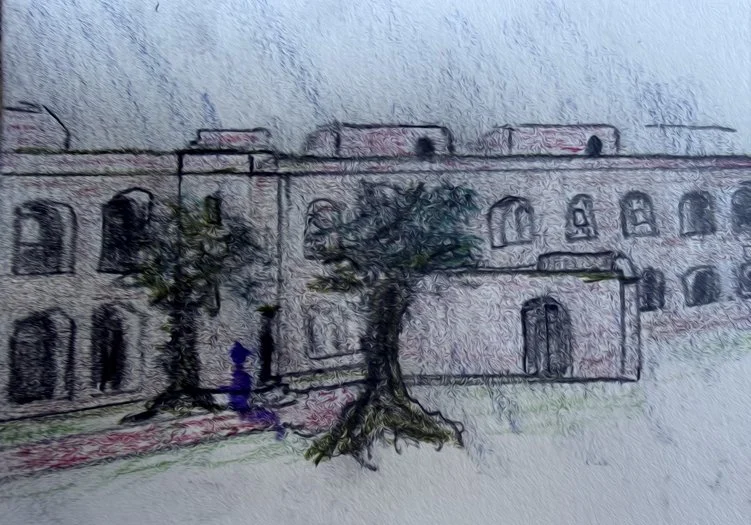
I’ve written about ghost stories from the Dry Tortugas before, and some of the other spooky stories about the park, and Fort Jefferson. The tale of Private Winters, isn’t as well known, and his life isn’t as well documented as the life of Dr. Mudd. The story about the potential ghost(s) in the Fort’s Rec room, is a shared experience that needs more investigation. (but it’s also in a closed off section of the fort, so it’s not as accessible to every visitor, and I understand why ghost hunters might not have found it.) And there are several other stories which do not rise to the same level of historical importance as Dr. Mudd’s, but contain a more plausible locus for any actual hauntings in the park.
But, Dr. Mudd, left the island. He died at home, and while he took from the Dry Tortugas the pain of imprisonment and several tragic stories, I do not see any reason he would be drawn back to the place after his death.
Instead, if someone wanted to ascribe whispers of tragedy, feelings of sadness, and other such spectral emanations to any figure from the Park’s past, I would posit a more sorrowful figure might still haunt the brick walls of Fort Jefferson.
Dr. Joseph (Jos) Smith was the physician assigned to Fort Jefferson when the Yellow Fever outbreak began. A young man, with a new career, he brought his son Henry Price with him to his post on the islands. While caring for soldiers sick with the disease, he fell ill himself, and died. His son, orphaned on the island, fell into the care of Dr. Mudd, who took over for Jos as he islands only doctor. (Eventually earning his pardon.) Unfortunately, despite Dr. Mudd’s best efforts, Henry also sickened and died. There’s a memorial to the doctor and his son in the parade ground inside Fort Jefferson.
It’s a tragic tale, as ghost stories often are. And I would posit, if ghost hunters are running into the specter of a tragic medical professional in the Dry Tortugas, then they have been miss-identifying the man for years. Perhaps, it’s not the ghost of a man who served his time on the island, and died a thousand miles away. Perhaps the haunting presence is the memory of a man much more connected in death to the island.
And this is not to account the other documented deaths out at the park. Sailors dead from shipwrecks. Soldiers, prisoners, and other victims of Yellow Fever, who died in the same outbreak as Dr. Jos Smith and those who died years later when Garden Key served as a Quarantine Hospital. That’s to say nothing of the other deaths. A few who died in accidents during fort construction. A prisoner who drowned during an escaped attempt, several escaped prisoners who vanished on a row boat into a storm and were never seen again. There are also stories of 2 members of Ponce de Leon’s crew buried on the islands, a history in the late 1890’s when the Fort remained a quarantine hospital for Yellow Fever Patients, and several other historical and more recent tragedies.
Basically, the sad fact of this tragedy is also a suggestion for future Dry Tortugas ghost hunters. Next time you interview ghosts in Fort Jefferson, instead of asking for Dr. Mudd, ask for Major Jos instead. and if you get the chance, check out the Rec Room too, because that is an area which needs more investigation.
October has only just begun. Prepare for more haunting facts as the month continues!
Sources for facts below: (Facts in this case can be other ghost stories, and other haunting tales,)
#41
Fragments of a news article from 1901 carrying the story: https://www.newspapers.com/article/chicago-tribune-ghost-ship-of-the-evergl/20930272/
Version of escaped pirate ship: https://evergladesareaguide.com/story/the-ghost-ship-of-the-everglades
Version of the cursed pirate ship: https://moonmausoleum.com/the-ghost-ship-of-the-everglades-of-cursed-pirates/
#42:
The legend of Black Caesar: https://www.britannica.com/story/black-pirates-and-the-tale-of-black-caesar
An version of the story about the ghost children on Elliot Key is amongst these ghost stories of the keys
#43
The story of Major Jos Smith can be found here
The ghost story about “Dr. Mudd” can be found https://moonmausoleum.com/ghostly-whispers-in-the-dry-tortugas-fort-jefferson/
A source on other ghost stories in the Dry Tortugas. (including some familiar tales.) Here
Photographic “proof “that the island is haunted. here
NPS documentation of the re-discovery of the hospital and a (now) underwater grave marker. Here.